Get Full Government Meeting Transcripts, Videos, & Alerts Forever!
Get email alerts on the County Budget topic
No spam. Unsubscribe anytime.
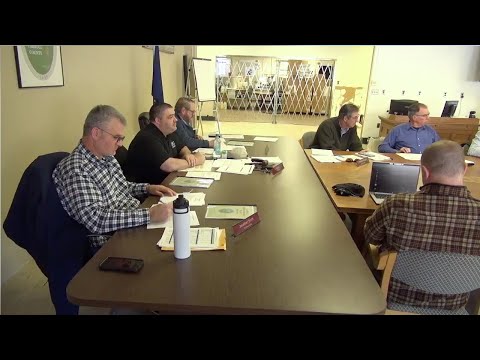
Carroll County delegation opens public hearing on proposed 2026 budget; approves multiple transfers
Summary
Delegates opened a public hearing on the commissioners' proposed 2026 budget, heard an overview from Commissioner McGee, discussed insurance, nursing-home finances and IT work, and approved a sequence of line-item transfers and contract authorizations ahead of executive-committee review.
The Carroll County delegation opened a public hearing on the commissioners' proposed 2026 budget on Dec. 12, hearing an overview from Commissioner McGee and approving a series of line-item transfers while referring the full budget to the executive committee for detailed review.
Commissioner McGee told the delegation the draft budget seeks to streamline accounting and align county accounts with the New Hampshire Department of Revenue Administration codes by consolidating roughly 81 previously separate lines for utilities and insurance into single accounts. "We combined the reason for doing the main reason for doing this is to better align with the DRA, financial codes for counties," the administrator said during the presentation. The administration also moved nursing-home capital into the nursing-home budget so that those costs are captured separately from the general fund.
Delegates pressed staff on specific items. Staff said health-insurance budgeting includes a cushion because a prior premium cap expired and final 2026 rates were not yet known; the administration explained it used a 10% general cushion and a 12% allowance for medical and nursing-home insurance pending year-end rate confirmations. "We just built in kind of the best guess of a cushion," the administrator said.
Nursing-home finances were a central focus. The nursing-home administrator reported projected favorable variances this year driven by payer mix and higher private-pay and Medicare residents, and said occupancy was about 99 of 103 with a waiting list. Delegates noted persistent staffing shortages and high agency-nurse costs; Representative Burrows suggested exploring cooperative housing for nurses to reduce reliance on agency staffing, an idea the nursing-home administrator described as "my major barrier to getting staff." The delegation asked staff to study feasibility; no commitment to fund such housing was made at the meeting.
Delegates also heard a technology update: the county is preparing to end a contract with Cybertron in March and bring systems in-house, with IT reporting the migration is about 90% complete and that multi-factor authentication and other security measures are being rolled out.
The meeting recorded several specific motions and approvals in support of year-end bookkeeping and operations. The delegation confirmed the commissioners' selection of auditors (the engagement and estimated cost were discussed), approved equipment and transition funding for the registry of deeds, and passed a set of transfers presented by staff including a $32,000 transfer tied to corrections-related needs and other smaller transfers for facilities, dietary payroll and overtime. The chair moved and the delegation voted to refer the budget to the executive committee for a close review; the delegation also approved the executive committee's authority to hire a delegation coordinator and to conduct a nonpublic follow-up on staffing/personnel matters.
Why this matters: the budget consolidations, insurance assumptions and the handling of nursing-home capital affect department-level reporting, potential future line-item transfers and how the county presents capital projects in a separate capital improvement plan. Delegates directed staff to provide an executive overview (a one- to two-page summary and the capital improvement plan worksheet) ahead of further review. Formal adoption of the 2026 budget is scheduled later in the budget calendar; the delegation set the executive committee to meet for detailed review before the March formal approval.
Provenance: Topic introduced at SEG 128 (opening public hearing) and continued through the meeting (topic coverage through SEG 2891).