Get email alerts on the Budget And Economic Development topic
No spam. Unsubscribe anytime.
Technical advisory group presents draft plan to address Eugene’s budget gap; council asks for data and specific targets
Summary
At a Dec. 8 Eugene City Council work session, a technical advisory group presented draft recommendations on operational efficiencies, revenue options and economic development to address a considered $10 million fiscal target; councilors asked for concrete numbers, benchmarking and outreach plans before committing to revenue or service‑priority changes.
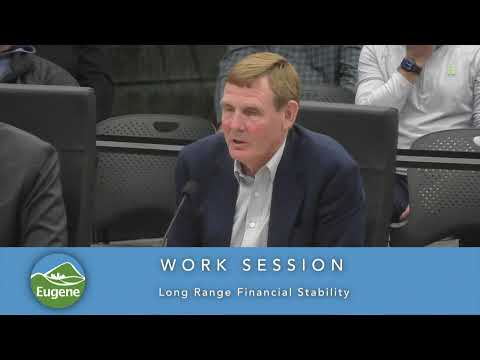
EUGENE, Ore. — A 12‑week technical advisory group (TAG) presented draft recommendations to the Eugene City Council on Dec. 8 aimed at shoring up the city’s long‑range finances through operational efficiencies, potential new revenues and an economic‑development push, and council members repeatedly pressed staff for more data and clearer targets.
Assistant Manager Matt Rodriguez, reading the TAG’s problem statement, told the council the city faces “both short and long term financial and strategic challenges,” and said “in the short term, expenditures are outpacing revenues, creating a structural imbalance amid broader economic uncertainty.” The committee organized its draft proposals into three focus areas — operational efficiencies and reductions, revenues, and economic development — and described implementation as short, medium and long term.
Why it matters: The TAG framed its recommendations against local economic trends shown in four presentation slides: Eugene’s post‑pandemic job recovery lags the national average, Oregon’s natural population change is projected to be negative (deaths outnumbering births), housing costs have outpaced incomes for decades, and the region trails peer university metros on per‑capita income. Those trends, the TAG said, constrain the city’s ability to grow revenues and sustain services.
What the TAG recommended: In the near term (6–24 months) the advisory group recommended identifying core city services and aligning the budget with stated priorities, engaging outside expertise to assess operations and seek cost savings, and communicating budget choices to the public. Longer‑term proposals include a strategic economic development planning process, coordination with regional partners, and advocacy for state‑level reforms where appropriate.
A fiscal figure discussed: The presentation noted a $10,000,000 fiscal target the TAG used for modeling potential combinations of revenue and efficiency measures. TAG members also left an unspecified longer‑term revenue target blank to refine later; Greg Irwin, TAG chair, told the council “we left it blank for a reason, and we will come back to you with that number.”
Council response: Councilors welcomed the TAG’s work but asked for more specificity before acting. Councilor Kaczynski pressed the group to explain how economic development would translate into general‑fund revenue given Oregon property‑tax limits. Councilor Zelenka said economic development alone is unlikely to close a $10 million gap and asked for a concrete estimate of annual revenue the strategy might generate. Councilor Leach asked whether the employment figures represented Eugene residents or jobs located in Eugene and why farm workers were excluded from the employment series; staff said they would follow up.
On workforce and contracting: When asked whether recommendations to “reduce employee costs” implied outsourcing, TAG members and staff said the group did not propose broad outsourcing but recommended exploring whether some services could be delivered more cost‑effectively through partnerships, and emphasized that personnel costs — more than 70% of the general fund budget — are where savings are most likely to be found.
Outreach and next steps: TAG members said they plan continued engagement and will return with a fuller report in early February. Staff noted communications work is underway to produce short informational segments to help educate the public about budget tradeoffs, and TAG members signaled willingness to participate in outreach materials.
No formal action or votes were taken during the work session; the TAG will meet again and present a full report and more detailed recommendations to the council in the coming months.
AI generated
The text on this page is AI generated. Summaries, highlights, analysis, and video transcripts are all produced from the original source material.
AI can make mistakes, so if you spot one, and we will fix it for everyone.
Note: the source content is unaltered by us. Any content source we link to, be it a video, an audio recording, or a document, is presented exactly as its publisher released it. That publisher is usually a government body, sometimes an individual official or another organisation.