
Hayden council authorizes 2026 Kootenai County policing contract after debate over costs and accountability
Get AI-powered insights, summaries, and transcripts
Subscribe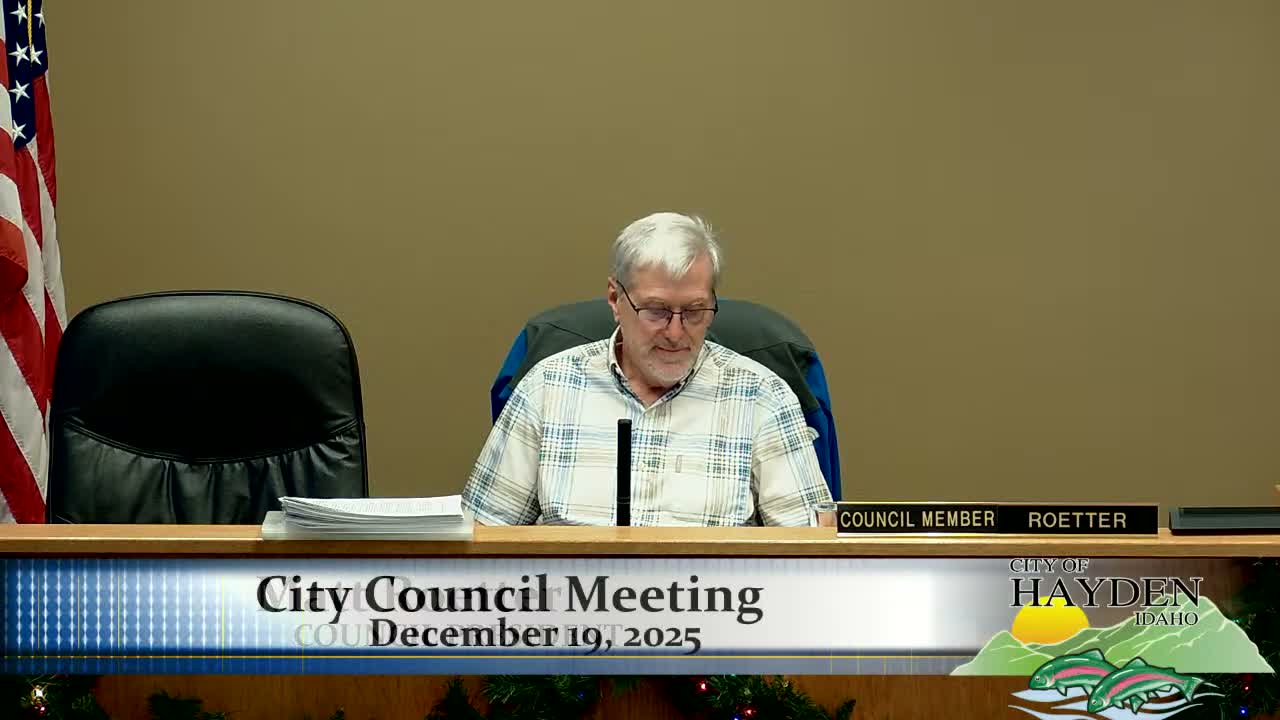
Summary
After a lengthy debate about staffing levels, tracking of deputy time and costs, the Hayden City Council voted to authorize the mayor to sign a fiscal‑year 2026 law‑enforcement contract with Kootenai County. Council members agreed to press the county for monthly time reports and set expectations for accountability.
The Hayden City Council voted on Dec. 19 to authorize Mayor to sign Kootenai County’s fiscal‑year 2026 law‑enforcement contract after hours of discussion about staffing, cost and the county’s ability to document how much time deputies spend in the city.
Council members said the county’s revised proposal reduces dedicated patrol staffing compared with the expiring arrangement. Council member Schaefer summarized the math in council discussion, saying the expiring 10‑deputy model cost about $954,000 and that the county’s revised model was described as a seven‑deputy option priced at $1,193,934 — “three fewer patrol deputies for $240,000 more,” she said. The point framed the meeting’s central trade‑off: fewer deputies or substantially higher costs.
The meeting included pointed accountability questions from a council member who said he had made extensive public‑records requests. He said the county “cannot prove the level of service that Hayden receives for that amount,” citing apparent gaps in time‑tracking, overtime attribution and monthly reports. He told the council he found records showing deputies assigned to Hayden responded to nearly 4,000 calls outside the city across a two‑year period and said some deputy time entries in production were implausibly large.
Public commenter Jeff Koder told the council that residents are concerned about the price tag and whether they will have a chance to vote on forming a city police department. “We can’t — I cannot afford it. Most people can’t,” Koder said, urging transparency and a transition plan if the city moves away from contracting with the sheriff.
Several council members urged compromise while seeking greater documentation. City staff and a county commissioner (referenced during the meeting) said the county should be able to furnish time‑in‑city reports and that producing them should be possible within roughly 90 days. Council members directed staff to ask the sheriff and county for monthly time reports showing hours deputies spend in Hayden and outside of it for fiscal‑year 2026.
After a brief recess to review a revised contract version that the county provided the morning of the meeting, the council took a roll‑call vote. Council president Rotor voted No; Council member Dupree voted Yes; Council member Schafer voted Yes. The motion to authorize the mayor to sign the county’s FY2026 law‑enforcement contract carried.
The council recorded next steps: (1) request and define the precise monthly time report the city expects from Kootenai County; (2) monitor the county’s production of those reports and (3) pursue additional analysis of alternative law‑enforcement models, including the feasibility and costs of forming a city police department. Several council members said they will consider issuing a 60‑day termination notice if the county does not deliver the requested accountability reports within an agreed time frame.
The council’s action allows the county contract to take effect while the city continues to press for detailed deployment and time reports so voters and officials can evaluate long‑term options.
The contract authorization is the most significant operational decision the council made at its Dec. 19 meeting; council also added a future agenda item in January to define the monthly time report they want and to monitor the county’s response.