Get Full Government Meeting Transcripts, Videos, & Alerts Forever!
Get email alerts on the Data Centers topic
No spam. Unsubscribe anytime.
Residents urge Hood County court to block data centers, cite water, air and health risks
Summary
Dozens of residents who spoke at the Dec. 9 Hood County Commissioners Court meeting urged the court to use Subchapter K authority, impose a moratorium, and deny tax abatements for proposed data centers and power plants over concerns about water withdrawal, air emissions and property values.
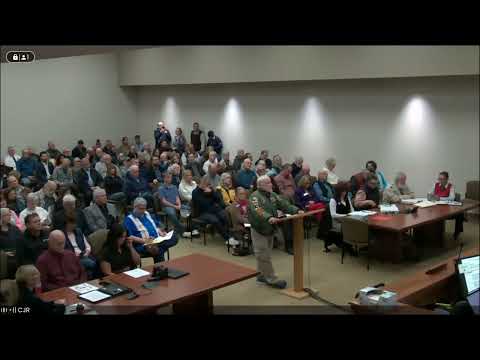
Granbury, Texas — Dozens of residents addressed the Hood County Commissioner's Court on Dec. 9, 2025, pressing elected officials to block or strictly regulate proposed large data centers and associated power plants that speakers said would threaten local water supplies, air quality and property values.
At the county courthouse, speakers invoked Subchapter K of the Texas Local Government Code and called for a moratorium on new data centers until cumulative environmental studies are completed. "We need to demand studies on the cumulative impact of massive water consumption as well as the impact of runoff water," said Brian Crawford, a Glen Rose resident who asked the court to refuse tax abatements for developers. "No more closed sessions — hearings where subject matter experts can debate real results," he said.
Why it matters: Residents argued the scale of proposed projects could alter Hood County's watershed and recreational character. Multiple speakers said the county already hosts several gas plants and that additional industrial projects could push the area into nonattainment for ozone and other pollutants.
Several speakers offered specific claims and requests. Scott Clayton, whose remarks centered on the 2018 death of his sister Ruby McPeters while in custody, urged the court to "put her name on the record" and to adopt a standing order barring county employees from soliciting override second opinions that contradict an attending physician's care for pregnant or postpartum inmates. "Violation means termination. No exception," Clayton said. Mary Jo Blomquist said Texas Commission on Environmental Quality staff had "rubber stamped" an air permit for a Pacifico Energy Partners plant she identified as Fort Spunky and reported the company's own materials list annual emissions near regulatory thresholds.
Other residents raised technical and economic concerns. Mitch Moore, who lives near proposed sites, asked how water‑use estimates were calculated and whether projected long‑term jobs would materialize. Kirk Teske, an architect, said developers use nondisclosure agreements that prevent transparency and recommended the county insist on stronger disclosures. "Without tax abatements, these projects are not nearly as lucrative to their investors," Teske said, urging commissioners to refuse abatements for limited‑liability companies and their tenants.
Court context and limitations: Speakers repeatedly cited Chapter 231, Subchapter K of the Texas Local Government Code as the legal basis for local action. County staff and counsel later told the court that while Subchapter K provides a framework, county powers are limited and some authorities such as ordinance/zoning are constrained at the county level. Commissioners acknowledged legal limits while noting the county had retained outside counsel to pursue negotiable protections and to advise on an implementation plan.
What residents asked for: Requests included a local moratorium on data‑center and power‑plant approvals, cumulative water and air quality studies (including TCEQ engagement), denial of tax abatements for data centers and associated power plants, monthly reporting on pregnant inmates in custody, and stronger transparency and plan review requirements.
Next steps: The court did not adopt a moratorium at the meeting. Commissioners said they would continue work on implementing Subchapter K through a newly created development commission and legal counsel, and several speakers were invited to provide input to that process. The court later appointed five members to a Hood County development commission and directed additional staff and attorney work on implementation.