Get Full Government Meeting Transcripts, Videos, & Alerts Forever!
Get email alerts on the Climate Action Plan topic
No spam. Unsubscribe anytime.
Humboldt County adopts regional climate plan and sets new greenhouse‑gas threshold
Summary
After months of debate, the Board of Supervisors certified the RCAP program EIR with errata, adopted the Humboldt Regional Climate Action Plan and set CEQA greenhouse‑gas thresholds at a board‑modified level intended to reflect county conditions while advancing 2030 reductions.
The Humboldt County Board of Supervisors on Tuesday certified a program environmental impact report and adopted the Humboldt Regional Climate Action Plan, moving the county to a formal framework for tracking greenhouse‑gas reductions and streamlining reviews for projects that meet the plan’s measures. The board also adopted a county level for CEQA greenhouse‑gas thresholds modified from the original guidance, aiming to balance statewide reduction goals with the county’s largely rural character.
The decision followed a multi‑hour presentation by county planning staff and consultants and a lengthy public comment period. Planning Director John Ford presented the RCAP’s technical basis, saying the county’s 2022 inventory found roughly 1,500,000 metric tons of CO2 equivalent and that on‑road transportation accounted for about 73% of emissions. Using the inventory, staff generated scenarios to show the reductions needed to align with state goals under SB 32 and AB 1279, and outlined strategies and actions across transportation, buildings, waste, water and carbon sequestration.
The accompanying program EIR found a mix of impacts. County staff said some future projects that implement the RCAP could cause unavoidable environmental effects — including impacts to scenic vistas, agricultural lands and biological or cultural resources — that could not be fully mitigated at the program level. Rodney Andel, explaining the EIR tiering approach, told the board that later, project‑level analyses would narrow those impacts and focus on site‑specific mitigations.
Central to the board’s discussion was a separate CEQA thresholds guidance document that translates county targets into per‑project screening levels. Staff presented three options: the consultant’s original set of thresholds (the most aggressive), a planning‑commission compromise and a staff‑recommended midpoint. After discussion and amendments on the dais, the board adopted the RCAP and certified the EIR including errata, and directed staff to adopt GHG thresholds at an intermediate level (the board settled on a modified level intended to better match Humboldt’s rural profile). Chair Wilson moved the package; the motion passed unanimously.
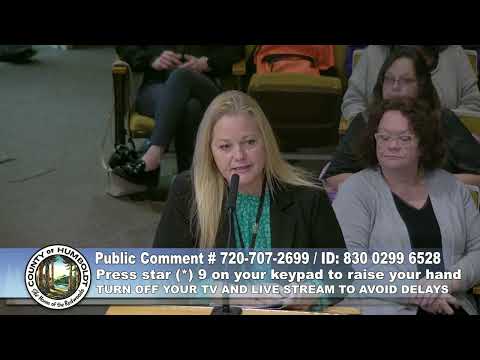
Supporters — including environmental groups and regional partners — told the board adopting a qualified plan will help the county access state and federal funding, streamline climate‑related reviews for projects that align with the RCAP, and create an institutional framework (a regional climate committee and a project manager position) for tracking progress. Critics and many rural residents urged caution, asking the board to preserve local land‑use flexibility and raise several questions about how thresholds and measures would affect small‑scale rural uses (for example, wood stoves and limited rural construction). The board directed staff to return with clarifications and additional detail on how particular measures will be applied, including follow‑up on Measure T3 (a connectivity/transit screening measure) and rural exemptions.
The board’s action authorizes the county to use the RCAP for CEQA streamlining when projects demonstrate consistency with the plan, and it directs staff to implement the RCAP tracking and reporting steps and to work with regional partners. The board also instructed staff to return with additional detail on implementation (including a staffing plan for the regional climate committee) and to address questions raised at the hearing about rural impacts and feasibility studies for certain measures.