
Caltrans outlines road-charge research and pilots; Humboldt audience raises privacy, equity and tribal concerns
Get AI-powered insights, summaries, and transcripts
Subscribe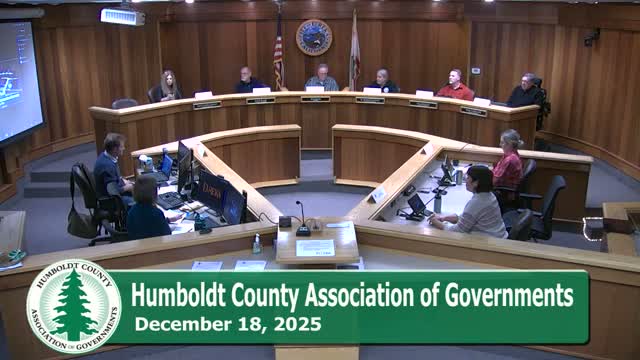
Summary
Caltrans and the California Transportation Commission presented road-charge pilots and a 10-year needs assessment, describing a per-mile model and pilot rate structures (one pilot used 2.8'cents/mile); residents and tribal interests raised privacy, cost and sovereignty concerns during public comment and board Q&A.
Caltrans staff and the California Transportation Commission presented an update on road-usage charge research and recent pilots at the Humboldt County Association of Governments meeting. Frances Tia Sanchez, needs assessment and road charge program manager at the California Transportation Commission, summarized statutory history and a 10-year transportation funding assessment; she and Caltrans colleagues described pilots testing technology, administrative approaches and rate structures.
Frances said the commission's 10-year needs assessment identified roughly $57 billion in statewide transportation needs versus about $572 billion in projected revenue (later adjusted to $541 billion), producing a multi-year shortfall staff said warrants developing sustainable funding options. "Road usage charges pay based on miles driven rather than on gallons of fuel," Frances said, noting the state has studied the option since SB 1077 launched the first pilots in 2014.
Caltrans discussed options for administration (potential DMV oversight with third-party account managers), multiple reporting options (odometer reads, plug-in OBD-II devices, GPS-based reporting) and privacy controls to let participants choose lower-tech, lower-sharing options. A Caltrans presenter described the rural-focused pilot (April'September 2023), reporting low private-road mileage among participants (~1.5%) but noting privacy concerns made GPS-style reporting unpopular for some residents.
The board and the public pressed Caltrans on rates and equity. Staff noted the research program ran pilots with a revenue-neutral design; the CTC set a pilot flat rate at 2.8'cents per mile for passenger vehicles in one revenue-collection pilot. "That, that's the question ultimately that will be decided by the legislature," the Caltrans presenter said when asked whether a road charge would fully replace the gas tax.
Public commenters raised several concerns: Julie (a resident) questioned costs and alternatives to road changes; a member of the Environmental Protection Information Center urged Caltrans to factor vehicle weight because heavier vehicles cause more pavement damage; and other commenters said mileage fees could disproportionately burden low-income and rural drivers. Caltrans responded that weight impacts are already addressed for commercial vehicles and that passenger vehicles (under ~10,000 pounds) make little difference to pavement damage; staff said commercial truck rate structures would continue to capture weight impacts.
Tribal sovereignty expressed during the pilot emerged as a consistent issue: Caltrans said tribes generally dislike the approach because of sovereignty concerns and that tribally owned gas stations (an estimated ~40) could lose competitive advantage if the gas tax were replaced statewide. Staff recommended tribal engagement at the federal level as well because federal funding is significant for tribal transportation.
Caltrans staff highlighted tradeoffs: GPS reporting gives precise accounting but raises privacy and data-processing costs; low-tech odometer reporting protects privacy but requires administrative checks. The Caltrans team said they will complete their reporting and present outcomes to the legislature and that any statutory changes would require legislative and possibly constitutional processes (two-thirds legislative vote and potentially voter approval for constitutional changes).
Caltrans provided links to reports and tools including a calculator that lets drivers estimate how a road charge would affect their household. Staff emphasized that no decision has been made and that the research program is meant to inform legislative options and potential phased approaches to maintain transportation funding.