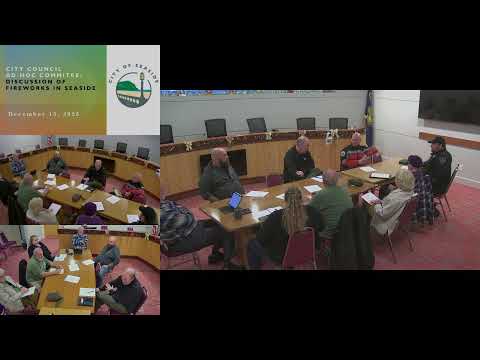
Seaside committee weighs stricter fines, education and beach enforcement for illegal fireworks
Loading...
Summary
A Seaside advisory committee debated a draft ordinance to raise fines and improve enforcement for illegal fireworks, emphasizing officer discretion, public education and coordination with state parks and Oregon State Police; members plan recommendations for the city council by late winter.
A Seaside advisory committee discussed strengthening penalties and enforcement for illegal consumer fireworks, focusing on repeated and reckless behavior on the beach and in neighborhoods. Committee members endorsed a combined approach of a graduated fine structure, a public education campaign, and clarified enforcement procedures to make fines more enforceable in municipal court.
Committee members said the goal is behavior change, not only higher fines. “If we can show we’ve done everything in our power to educate you — billboards, signs, handouts — it’s easier to write those tickets and enforce them,” Speaker 5 said, arguing that visible education can influence municipal judges’ decisions. Members cited Cannon Beach’s strict approach as an example and discussed starting with lower first-offense penalties and escalating them for repeat or egregious conduct.
Speakers raised practical enforcement challenges. Officers said proving who hurled fireworks from a moving vehicle or a hotel balcony is often difficult without witness identification. “If we can see the mortar tubes, we take them,” Speaker 5 said, describing current practice of seizing illegal fireworks, staging vehicles to transport confiscated items, and then coordinating disposal with Oregon State Police. Members noted that malicious or clearly dangerous acts (for example, throwing mortars into crowds) are more likely to be prosecuted in circuit court as criminal charges rather than handled through municipal ordinance fines.
The committee also discussed jurisdictional and operational details: Seaside has a memorandum of understanding that allows enforcement of certain beach rules on behalf of state parks, but state officers and municipal authorities use different statutory tools. Members stressed the ordinance should avoid overly complex location-based rules and instead rely on a recklessness standard with enhancements during fire season to keep enforcement practicable.
On process, staff and the committee agreed an ordinance would require three readings and likely at least six weeks to complete; speakers suggested aiming for council consideration by March and beginning a PR campaign in advance so the public and the municipal judge are aware of outreach efforts. The chair asked members to draft recommended penalty levels and email them for a follow-up meeting in late January or February.
Next steps: the committee will finalize recommended fine levels and enforcement language, schedule a subsequent meeting to consolidate homework, and prepare a package for the city council.