Neighbors press for stronger protections of Carrillo Adobe as developers propose 162 townhomes in Santa Rosa
Loading...
Summary
At a neighborhood meeting on a preliminary Creekside Village concept, the developer and planners described a 162‑unit townhome project and preservation intentions for the Carrillo Adobe; many residents pushed back, citing loss of sight lines, archaeological and environmental risks, parking and traffic strain, and calls to secure park and Adobe preservation before housing construction.
Serena Lino, the administrative services officer helping facilitate the meeting, opened a neighborhood meeting in Santa Rosa to gather feedback on a preliminary concept for Creekside Village, a proposed townhome project. City staff and the applicant emphasized that no formal applications had been filed and that the meeting was for concept review and public input.
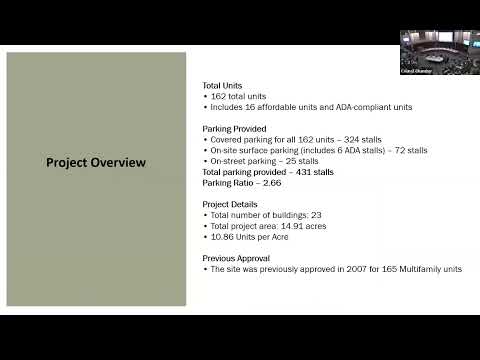
Senior Planner Kristany Tumians told the room the concept proposes roughly 162 three‑story townhome units on about a 14.9‑acre property with a 10.77‑acre project footprint. She said the site is designated medium‑density residential (8–18 dwelling units per acre) and that formal entitlement filings, a tentative map, and major design review applications — plus technical studies such as traffic and environmental reviews — would follow if the applicant proceeds. "No formal applications have been filed yet," Tumians said, and the city will mail notices to properties within 600 feet once a formal application is submitted.
The developer’s representative, Mark Polarczyk of Swenson, presented the conceptual site plan and said the team intends to preserve parkland and stabilize the Carrillo Adobe. Polarczyk described a parking strategy that he said provides a parking ratio "of over 2 and a half to 2.66," roughly 23 buildings, and a reduced unit count from a prior entitlement (165 to 162). He said the project would adhere to previously approved infrastructure alignments and meet current design standards.
But public comment was dominated by concerns about the Adobe and the park. Larry Carrillo of Friends of the Carrillo Adobe told the meeting the proposed buildings "completely blocked the visibility of the Adobe" and said the current maps presented "don't match the maps" stakeholders have seen from earlier approvals. Multiple speakers said the park area appears to have shrunk compared with prior documents and urged the city and developer to ensure the Adobe’s visibility, access, and long‑term preservation.
Local archaeologist Alex DiGiorgi said the prehistoric archaeological site and the Carrillo Adobe are listed on the California Register of Historic Resources and warned that portions of the development footprint include significant prehistoric deposits, including Native American burials. He asked how the lead agency would avoid or mitigate adverse effects on those resources and how recent state streamlining changes (identified in comments as "AB 130") would interact with CEQA protections for a resource already listed prior to an application.
Tribal member Joe Salinas said human remains had been found on the property in prior investigations and urged the city to respect indigenous sites and preserve the land rather than permit development that would encroach on burial and village areas. Several speakers — including long‑time residents and members of local historical groups — asked that park development and Adobe stabilization be required before or independent from housing construction rather than deferred to an unspecified future date.
Other recurring concerns included traffic and parking. Neighbors described existing congestion along Montgomery Drive and at the Hahman–Montgomery intersection, questioned whether the project’s parking would be sufficient for households with multiple vehicles, and asked when a traffic study would be completed and what mitigation standards would apply. Tumians said a traffic study is required after a formal application and would be public; she added that safety recommendations in such studies would be mandated if the study identifies problems.
Supporters of the project, including nearby residents and several speakers who said they want young families to remain in Santa Rosa, argued the site is appropriate for denser, walkable housing near transit and services. Those speakers urged thoughtful design that preserves the Adobe and improves pedestrian and bicycle connections to encourage lower car use.
On affordability and design details, the applicant said the proposal is currently a for‑sale product with a requirement that "over 10%" of units be reserved as Below‑Market‑Rate (BMR); the developer noted standard regulatory agreements that commonly run for multiple decades (commenters referenced a 55‑year term). The team also said about 10% of units would be adaptable to full accessibility standards.
What happens next: city staff reiterated this was an early‑stage neighborhood meeting; no actions were taken. If the applicant files a formal application, the city will require technical studies (traffic, environmental, archaeological), circulate public notices, and take the project through planning and design review steps where the public will have additional opportunities to comment. Members of the public and heritage advocates urged the city and developer to secure legally binding commitments for Adobe stabilization, to preserve a full contiguous park area, and to address traffic and parking through mandated mitigations before housing construction is allowed to proceed.
The applicant and staff were available to answer additional questions after the meeting, and the city encouraged written comments via the planner’s email and comment cards.