Get Full Government Meeting Transcripts, Videos, & Alerts Forever!
Get email alerts on the Crime Statistics topic
No spam. Unsubscribe anytime.
SPD presents year-to-date drops in homicides and shootings; RTCC, Magnuson Park pilot and hiring cited as factors
Summary
Seattle Police Department officials told the Public Safety Committee that homicides and nonfatal shootings fell significantly through November, highlighted activity by the Real Time Crime Center, and described a Magnuson Park neighborhood-officer pilot and notable hiring gains; a full NIBRS report is expected in February.
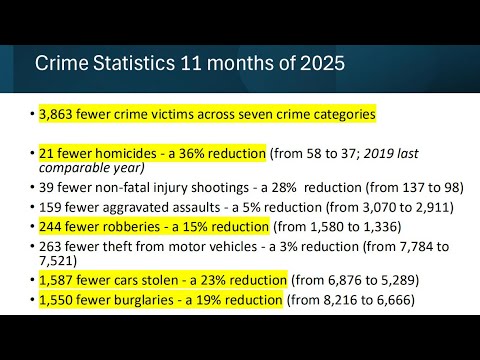
Lee Hunt, executive director of Crime & Community Harm Reduction for the Seattle Police Department, told the Seattle City Council’s Public Safety Committee on Dec. 9 that preliminary year-to-date data through November show notable declines across several major crime categories. "We've had across seven significant categories through the November more than 3,800 less victims of crime," Hunt said, and added the city recorded a roughly 36% reduction in homicides and a 28–33% reduction in nonfatal shootings in the eleven-month period.
Hunt previewed a full National Incident-Based Reporting System (NIBRS) report scheduled for February and said the department will publish a preliminary report in early January while records continue to be processed. He attributed reduced seasonal spikes this year to a combination of interventions — from targeted patrols to public education campaigns — and noted a specific city ordinance aimed at nightlife contributed to fewer after‑2 a.m. shootings: a slide prepared by the city attorney’s office showed nightlife shootings after 2 a.m. fell from 18 incidents pre‑ordinance to six after, a decline the department cited as a 66% reduction.
The presentation summarized a 90‑day neighborhood resource officer pilot at Magnuson Park where two volunteer officers "built relationships," recovered multiple firearms and helped locate a homicide suspect. Hunt said property‑crime counts and low‑level violent incidents in that pilot area dropped during the trial; slides reported robberies down 86% and motor‑vehicle theft down 61% in the park area over the period shown. He noted violent‑crime counts there were small enough that some measures were not statistically robust.
Hunt also described the Real Time Crime Center (RTCC): 66 cameras were authorized and 62 were functioning at the time of the briefing, covering approximately 1.04 square miles (about 1.14% of the city's land area) concentrated in North Aurora, the Chinatown‑International District and the downtown 3rd Avenue corridor. "We currently hold monthly meetings with the OIG and the research team, and we are collecting data and reports for analysis for the researchers to utilize," Hunt said, referring to an independent evaluation the department contracted with the University of Pennsylvania. He said the RTCC had supported about 956 crime events by November and that roughly 54% of those events resulted in an associated arrest or led to probable cause that enabled later arrest.
On privacy safeguards and data management, Hunt said analysts and a limited set of technology staff and supervisors have access to the RTCC platform, footage is retained for five days, privacy pixelation masks apartment windows and the system covers public space only. He told the committee that more than 12,000 video clips had been uploaded to the department’s evidence system for law‑enforcement use.
On personnel, Hunt said the department’s net officer count improved by about 94 officers compared with last year; SPD hired 159 officers this year versus 70 the prior year. He credited a mix of factors — compensation changes, process improvements that shortened application and background timelines, and other recruitment investments — while acknowledging there is no single ‘‘magic wand’’ behind the increase.
Council members pressed for clearer public communication about the RTCC and camera safeguards. Council member Hollingsworth urged SPD to produce short, accessible materials and timelines so residents understand when cameras will be installed, who can access footage and how privacy protections work. Council president Nelson and others asked for additional detail about how automated license‑plate readers are used; SPD clarified ALPRs primarily flag vehicles already listed as stolen in national databases and are not inherently preventative of theft.
The full NIBRS report and additional datasets are scheduled for public release in February, and Hunt said the department will return with further analysis and requested follow‑up on specific questions about temporal patterns, arrests tied to camera evidence, and recruitment metrics.