Get Full Government Meeting Transcripts, Videos, & Alerts Forever!
Get email alerts on the Police Contracts topic
No spam. Unsubscribe anytime.
Seattle Council Approves Police Labor Deals After Heated Public Comment
Summary
After more than an hour of public testimony denouncing police violence and demanding stronger civilian oversight, the Seattle City Council approved a management contract for lieutenants and captains and a disputed officers’ contract that critics say weakens accountability. The SPMA measure passed unanimously; the SPOG contract passed 6–3.
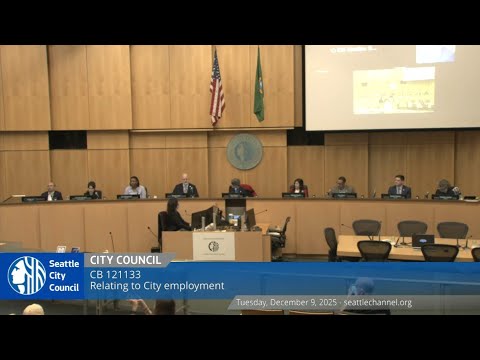
Seattle’s City Council on Dec. 9 approved two police labor agreements — a collective bargaining deal for lieutenants and captains and a separate contract for rank-and-file officers — after extended public comment and a contentious floor debate over accountability and subpoena powers.
The council passed the Seattle Police Management Association (SPMA) agreement by a 9–0 roll call after committee sponsors presented the contract as aligned with the city’s 2017 accountability ordinance. Clerk read council bill 121,132, which the council adopted to cover lieutenants and captains through Dec. 31, 2027.
Opposition focused primarily on the Seattle Police Officers Guild (SPOG) contract, which the council approved on a later roll call by 6 votes to 3. Critics, including dozens of public commenters, said the SPOG deal does not give civilian oversight bodies adequate subpoena authority and preserves disciplinary protections that impede transparent investigations.
"This contract still does not meet the baseline set by the 2017 accountability ordinance," said Kate Rubin, a Beacon Hill resident and accountability advocate, during public comment. "Approving a contract without real enforceable accountability creates a permissive environment for police misconduct and violence."
Speakers at the podium and on the phone recounted experiences tied to policing during May protests and other incidents. Gabriel Diaz, who said he participated in a review of police response in Capitol Hill, described mass arrests and force he called "unjust," and said the Office of Police Accountability sustained no obligations against officers in those cases.
Council debate reflected the split between members who said the contracts advance public-safety reforms and those who said the agreements sacrifice accountability. Council member Rink said the SPOG contract "asks Seattle taxpayers to invest more in policing without requiring more accountability in return," and announced a no vote. Another councilmember (speaker 7) said the contract contains "some cool things" such as care-team expansion and bonuses but warned that "without subpoena power investigators cannot require officers or witnesses to participate" and cited central-staff estimates that the contracts would add “tens of millions” to baseline costs over four years (cited figures included about $12,000,000 in year 1 and $22,000,000 in year 2).
Sponsors and proponents argued the agreements are the practical means to expand alternative-response programs, retain staffing, and create a path to arbitration on tougher accountability measures. The sponsor said the Office of Police Accountability and the Office of Inspector General "can and have subpoenaed records" under city ordinance 126,264, while acknowledging limits on access to officers’ strictly personal records.
The council paused briefly amid chamber disruptions, recessed for five minutes, reconvened and completed the SPOG vote by roll call. The clerk recorded the SPOG tally as 6 in favor and 3 opposed; the chair signed the legislation.
The council did not adopt all requested accountability changes at the local level; several members urged state legislative action to remove police-discipline matters entirely from routine bargaining. The council also directed ongoing work between the city’s labor relations staff and accountability partners to pursue further reforms.
The measures will take effect per the contract timelines and related ordinances; council members said implementation, oversight and any arbitration steps will be monitored in the coming months.
The council moved on to additional agenda items after the votes, including routine pay-zone adjustments and adoption of a state legislative agenda. The meeting recessed and reconvened as needed to complete votes.