
Council adopts ethics bill restricting certain consultant activity and adding disclosures after contentious amendment votes
Get AI-powered insights, summaries, and transcripts
Subscribe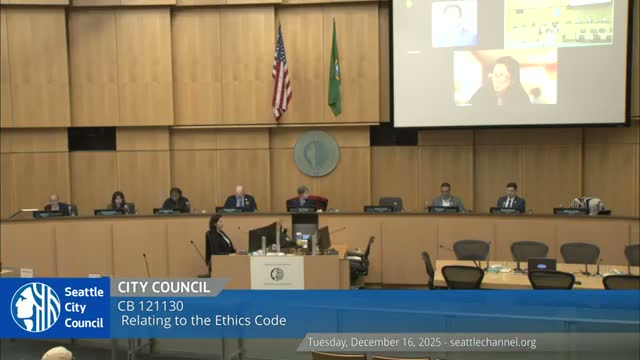
Summary
The council passed CB 121130 with multiple amendments requiring disclosures to the Seattle Ethics and Elections Commission and consultation on future ethics rule changes; the final vote was 6–2 after debate over reporting, prohibitions and a cooling-off period.
The Seattle City Council passed CB 121130, an ordinance aimed at addressing perceived conflicts of interest when political consultants contract with the city and simultaneously do campaign work. The bill initially proposed prohibiting concurrent political consulting and establishing a cooling-off period; during full council consideration three substantive amendments were adopted.
Amendment A reinstated reporting requirements modeled on peer-city practices and passed 6–2 after floor debate. Amendment B formalized consultation with the Seattle Ethics and Elections Commission (SEEC) on future code changes and delegated rule-making authority options; it passed 7–1. Amendment C required disclosure to SEEC by political consultants who accept city contracts, to make potential concurrent roles transparent; it passed 5–3. Proponents said the package increases transparency and public trust; opponents cautioned that some reporting duplicates existing disclosures and that the bill needed more time for review.
Councilmember Strauss, sponsor of one amendment, said reinstating reporting would align Seattle with San Francisco and Portland practices. Councilmember Rivera argued that some of the reporting duplicates information already reported to campaign disclosure entities and urged tailoring to avoid unnecessary duplication. After amendment votes the amended bill passed on final roll call (6 in favor, 2 opposed). The chair said the adoption is a meaningful start to strengthening public trust.
Next steps: the SEEC will be involved in implementing disclosure procedures and the council expects central staff to refine processes and coordinates follow-up rulemaking as needed.