
Kuna Council approves 242‑acre Napa Vineyard subdivision after debate over traffic and schools
Get AI-powered insights, summaries, and transcripts
Subscribe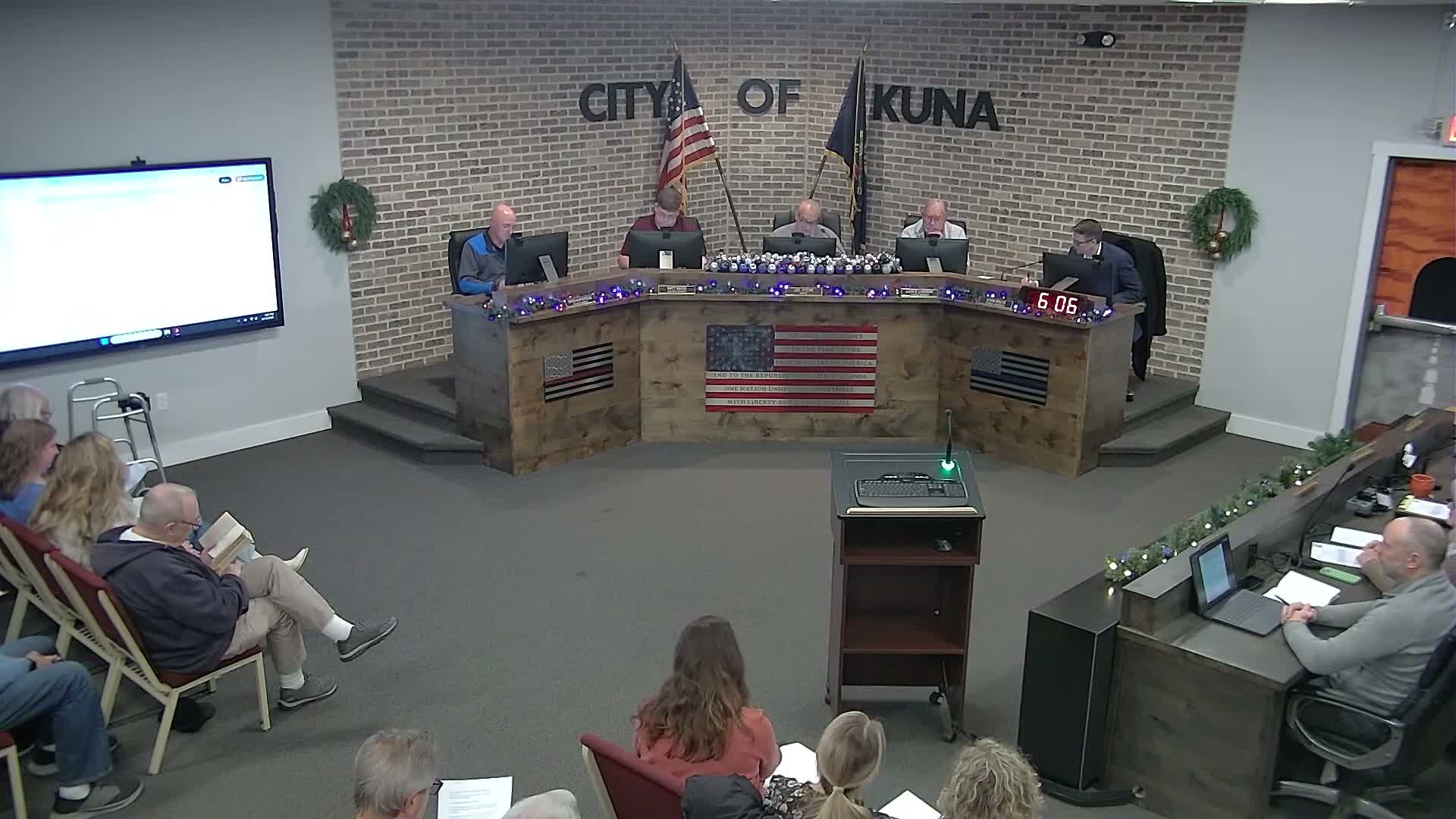
Summary
Kuna City Council approved the Napa Vineyard planned unit development, preliminary plat and limited rezones for a 242‑acre project after residents and some council members raised concerns about traffic capacity and school overcrowding; the council vote was carried by Mayor Steer’s tie‑breaking yes.
KUNA, Idaho — The Kuna City Council voted to approve the Napa Vineyard planned unit development, preliminary plat and rezoning requests on Tuesday, carrying the motion with a mayoral tie‑breaking vote after an hours‑long public hearing and deliberation.
The approvals cover a roughly 242‑acre property that staff and the applicant said was annexed and zoned into the city in 2009 and is proposed to be subdivided into a mix of residential lots, a school site, a fire station site and about 17 acres of commercial uses. Troy Bihunan of Kuna’s Development Services told council staff found the PUD, preliminary plat and limited rezones to be technically compliant with city code and the city’s recently modified development agreement.
Why it mattered: Hundreds of nearby residents and several council members pressed for clarity on when traffic and school improvements would be built and who would pay for them. Opponents said existing roads — including Meridian, Columbia and 10 Mile — are already over capacity and that the school district’s long‑term capacity plan does not guarantee new classrooms will be available when students arrive.
What supporters and the applicant said: Stephanie Hopkins, representing the applicant, described the project as an infill‑style subdivision with 747 total lots on the preliminary plat and multiple build phases. “This project was entitled back in 2009,” Hopkins said, adding the proposal is phased (11 phases) and that the multifamily component allowed by the original agreement is not part of tonight’s preliminary plat approval. Hopkins said the plan includes about 18.7% open space (roughly 45 acres), a centrally located park and a school lot that Kuna School District has first right of refusal.
The applicant’s traffic engineer, Sonia Deliden of Kittleson and Associates, told council the traffic impact study used a 10‑year build‑out horizon to 2035, covered 12 intersections and multiple roadway segments, and was reviewed and accepted by the Ada County Highway District (ACHD) and the Idaho Transportation Department (ITD). “The study has been reviewed and accepted by both ACHD and ITD,” Deliden said, and she described near‑term mitigations that the development will fund, including new collector roadways, turn lanes and new signals.
Numbers and funding: The applicant said ACHD impact fees are approximately $5,800 per lot and estimated the development would pay roughly $3.8 million in ACHD fees from the single‑family lots on the plat; the presentation also cited about $465,000 in contributions to ITD and a developer‑estimated total of roughly $6.8 million in impact fees to local agencies to mitigate growth from this project. The application materials and staff reports state the majority of the required street and intersection work for the project will be developer‑funded rather than paid by property taxes.
Residents’ concerns: Dozens of residents urged delay or denial, citing traffic, school overcrowding, water pressure and lot density. “There’s way more traffic than the roadway can handle,” said Dave Splitt, who lives near the area, urging council to defer building permits until road capacity is improved. Melissa Dean told council “the infrastructure right now is not adequate,” and several speakers said ACHD’s timing for regional corridor work stretches to decades and offered little near‑term certainty.
School capacity was another recurrent worry. Tim Jensen of the Kuna School District said the district appreciates the donated school lot but emphasized that increasing capacity typically requires a bond and that bonds require voter approval; he said portables and other stopgap measures are costly. Multiple council members asked the district to provide clearer information about current capacities and what the donated lot would realistically deliver.
Council debate and legal limits: Council members acknowledged the community’s frustration but were divided about what legal grounds the city had to deny or limit a plat that staff described as technically compliant. City attorney Mark Fybe cautioned that moratoria and denials carry legal limits and that any denial must identify the specific code standards and actions the applicant could take to address the deficiency. Several council members said they were uncomfortable approving a large project while infrastructure and schools remain strained; others noted the property’s long‑standing entitlements and the narrow scope of a technical compliance plat review.
Final action: After deliberation a motion to approve the PUD, preliminary plat and rezoning was moved and seconded. A roll call produced a tie among voting council members; Mayor Steer cast the deciding vote in favor and the motion carried. The council recessed briefly to move on to other business.
What’s next: The preliminary plat approval allows phased platting and site work under the conditions set in staff recommendations and the development agreement; future applications for multifamily units or other discretionary permits would require further review and potentially additional traffic analysis and mitigation. The project team and city staff will be responsible for scheduling triggers and constructing the developer‑funded road improvements required by ACHD and ITD.
— Reporting by the Kuna City Council meeting record and public testimony.