
McCall council adopts TIA guidance, strips "intended for local residents" language
Get AI-powered insights, summaries, and transcripts
Subscribe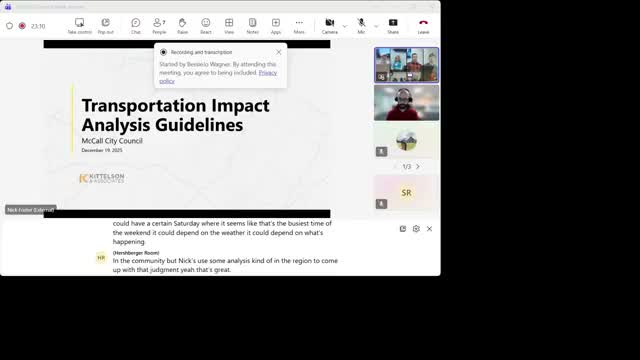
Summary
The McCall City Council voted unanimously to adopt a Transportation Impact Analysis guidance document (Resolution 26-4) and removed the phrase "intended for local residents" from item 6.3 after discussion about level-of-service thresholds, seasonality, and scoping procedures.
McCall City Council members voted unanimously to adopt a Transportation Impact Analysis (TIA) guidance document and to remove the four words "intended for local residents" from item 6.3, Mayor and council members announced after a roll-call vote.
The council’s decision followed more than an hour of discussion about how the draft guidance treats trip-generation categories, level-of-service thresholds, seasonality and pedestrian counts. Nick Foster, a traffic consultant with Kittleson in Boise, told the council the guidance uses a standard ITE 210 single-family description — typically owner-occupied or long-term rental — and that the manual’s land-use categories were developed from older studies. "The 210 is your standard single-family home, generally in a suburban city environment," Foster said.
Council members pressed staff and consultants to make the scoping meeting the place where project-specific assumptions are set. One council member said McCall’s community currently includes many second homes and that scoping allows the city and the developer to agree on an anticipated mix of local residents versus short-term or second-home occupancy, which affects trip-generation inputs. "If this community is gonna change to more of a locals community, then probably our city engineering team needs to use that as the bar," Speaker 1 said.
Members debated the wording that triggers mitigation, focusing on whether "below D" (the draft language) meant only LOS F or should be read as "D or below" so mitigation could be considered at a D condition. Staff and consultants explained LOS letters are shorthand tied to seconds of vehicle delay; consultants said the models can and sometimes do include pedestrian and bicycle crossings when scoping calls for those counts. Foster summarized the seasonality analysis using Idaho Transportation Department automatic traffic recorder data south of McCall, noting July volumes typically peak on Fridays and that hourly spikes commonly occur around 4–5 p.m. "You can see generally the highest volumes on a Friday, especially the month of July," Foster said.
After extended discussion about balancing safety, community character and the cost of mitigation — particularly in downtown areas where widening to achieve a higher LOS would be undesirable — the council proceeded to a motion. Speaker 6 moved to remove the words "intended for local residents" from item 6.3 and to approve Resolution 26-4 adopting the TIA guidance; Speaker 5 seconded. The council conducted a roll-call vote and the motion carried unanimously.
The action authorizes the mayor to sign any necessary documents to enact the guidance. Council members said the document is intended to set baseline scoping and analysis expectations and that finer-grain decisions (for example, where LOS D might be preferred in certain corridors) would be addressed in the broader transportation master-plan process. The meeting recessed for five minutes after the vote.