Get AI Briefings, Transcripts & Alerts on Local & National Government Meetings — Forever.
County staff warn HUD’s withdrawn CoC NOFO could threaten permanent housing and put hundreds at risk
Loading...
Summary
Multnomah County’s Homeless Services Department told commissioners that HUD’s withdrawn 2025 Continuum of Care NOFO would cap permanent‑housing funding at 30 percent, shift money to transitional programs, and could put roughly 800 households at risk and expose the county to a potential ~$25 million reduction in federal CoC funding unless mitigations succeed.
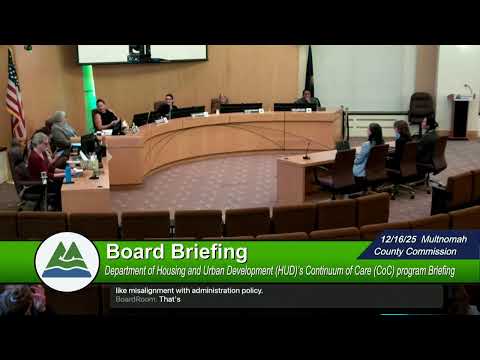
Anna Plum, interim director of the county’s Homeless Services Department, told the Board of Commissioners that staff are preparing for the possibility that HUD will reissue the 2025 Continuum of Care (CoC) notice of funding opportunity (NOFO) with the same substantial policy changes. Plum said the county will likely return to the board for a vote to forward the consolidated CoC application to HUD — tentatively scheduled for Jan. 8 — but the timeline and content remain uncertain while litigation and a HUD review proceed.
Erin Pedot, a Homeless Services program manager, summarized the risks staff are planning for: "These new HUD policies threaten to defund longstanding permanent housing programs and to displace about 800 households in our community," she said, noting the NOFO would cap permanent housing funding at roughly 30 percent and prioritize transitional housing and street outreach.
Why it matters: Multnomah County’s CoC funding currently supports hundreds of permanent supportive housing (PSH) units and other long‑term programs that serve people with disabling conditions. Staff warned that the NOFO’s structure could reallocate tens of millions of dollars away from permanent housing and that contracting delays or reallocation could produce funding lapses that providers cannot weather.
Key details from the briefing: staff reported current CoC annual renewal demand in the $36M–$37.6M range across 33 grants and 17 organizations, with most funds (historically) supporting permanent housing. Under the withdrawn NOFO’s structure, staff estimated the community could lose as much as about $25.3 million in federal funding for permanent housing and that approximately 800 households (about 600 in PSH) might lose their services if replacements are not found.
Policy and program shifts in the NOFO: presenters said HUD’s 2025 NOFO would 1) make most CoC funding nationally competitive rather than locally protected, 2) cap permanent housing at 30 percent of awards, and 3) include language allowing HUD to reject projects for reasons that include perceived inconsistencies with the administration’s stance on DEI or gender‑identity practices. Staff called those provisions a reversal of long‑standing HUD priorities, including the "housing first" approach.
County response strategies: staff described a multi‑track response: regional coordination with Clackamas and Washington counties and Metro; aggressive outreach to new and existing transitional housing and street‑outreach providers (54 letters of interest from 31 organizations for the local application); technical assistance to support provider conversions; conversion of eligible rapid rehousing projects to transitional housing where providers consent; pursuit of national advocacy and litigation; and contingency planning (pausing referrals to at‑risk PSH projects, compiling lists of impacted households, reorienting coordinated entry, exploring move‑on supports and matching households to other local resources).
Legal and political context: staff noted HUD withdrew the NOFO after lawsuits by states and national groups; commissioners said they expect continued legal and political activity and asked for a concise, single‑page summary of all locally impacted permanent housing projects. Commissioner Loretta Singleton called the NOFO "bigotry" and urged the county not to normalize the policy shift.
What comes next: staff will complete local application rating/ranking this week, return to the board (tentatively Jan. 8) to forward applications to HUD pending further federal developments, and continue contingency planning for households and providers at risk.