
Oxnard police chief: staffing gaps and overdose surge are straining response goals
Get AI-powered insights, summaries, and transcripts
Subscribe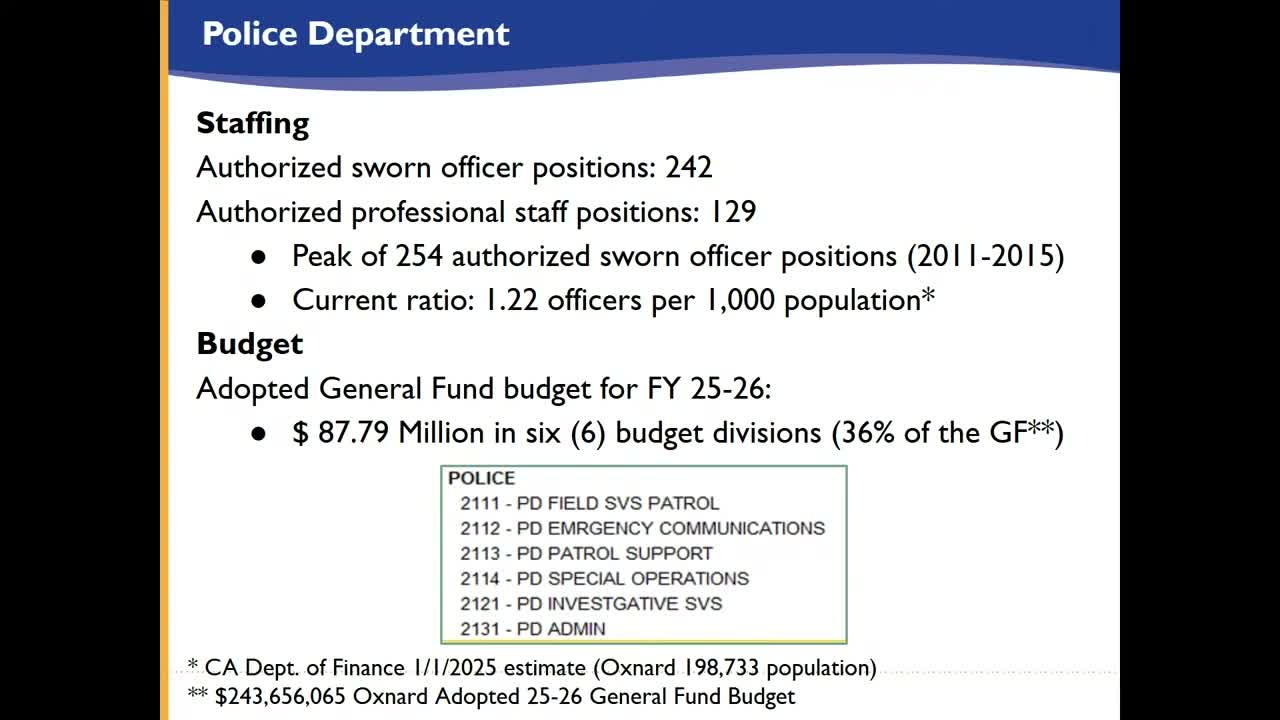
Summary
Police Chief Jason Benitez told the Oxnard City Council the department has maintained sub‑5‑minute response times for highest‑priority calls but faces persistent vacancies, rising overdose incidents and costly encampment abatements as it seeks to restore neighborhood policing.
Police Chief Jason Benitez presented the Oxnard City Council with an overview of department priorities, staffing challenges and public‑safety trends, saying the department is balancing rapid emergency response with mounting demands from overdoses, homelessness and traffic collisions.
Benitez said the department’s goal remains to "generally arrive to the highest priority emergencies in 5 minutes or less," and that the agency has largely maintained that standard despite staffing shortfalls in recent years. He told council the department’s authorized complement is 242 officers, down from a recent high of 254 between 2011 and 2015.
Benitez described a workload of roughly 118,000 calls for service a year and said calls involving people experiencing homelessness accounted for nearly 10% of that total last year — about 11,000 calls. He said two large encampment abatements last year cost "millions of dollars" and required coordination with multiple jurisdictions and public works resources.
Traffic safety remains a concern: Benitez said Oxnard ranks among the higher‑risk cities in its cohort for injury collisions and for DUI‑related collisions, and that injury collisions average about 1,000 per year. He said the department requests grant funding from the California Office of Traffic Safety for DUI checkpoints and specialized enforcement.
On drugs and overdoses, Benitez said fentanyl and methamphetamine are leading narcotics encountered by officers. He reported 535 overdose incidents in 2024 when police, fire and EMS responded and said officers applied naloxone (Narcan) 84 times in the most recent year. According to Benitez’s slides, opioids accounted for 53 of 61 overdose deaths referenced in the presentation.
Staffing shortages were a recurrent theme. Benitez outlined vacancy and attrition pressures — he said the department typically sees 9–13 service retirements in a year and that non‑productive positions (officers in training, on injury or family leave) further reduce field availability. He noted the department received 778 applicants but that only a small fraction progress to hire, citing a figure he described as "maybe 3%" who meet hiring requirements.
To preserve core emergency response, Benitez said members of the neighborhood policing team were temporarily reassigned to patrol; three‑quarters of those officers’ time is spent on patrol shifts. He said recent shift selections increased patrol picks to 90 officers and the department plans to return staff to neighborhood policing as vacancies are filled.
Benitez urged the council to consider workforce supports and professional staff that can free sworn officers for field duties — for example, civilian positions to take reports — and emphasized wellness and peer‑support programs for officers.
The presentation was framed as a briefing for council priority setting; Benitez said he would make himself available for questions and did not present a formal motion for council action during the update.