
Historic preservation panel denies request to replace 1916 slate roof; homeowner cites cost and insurance barriers
Get AI-powered insights, summaries, and transcripts
Subscribe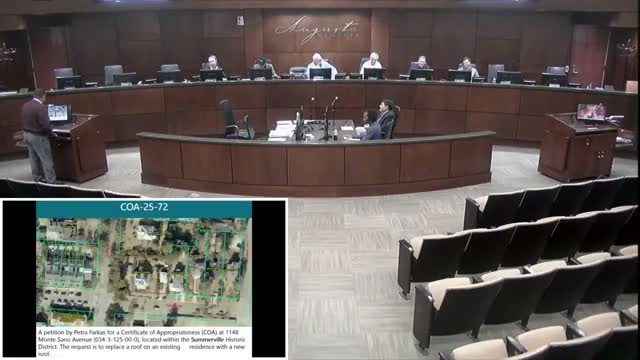
Summary
The Augusta Historic Preservation Commission denied a petition to replace a 1916 slate roof with architectural shingles after staff said the original slate is a character-defining feature; the 92-year-old homeowner and representatives said slate or synthetic slate would add $50,000–$57,000 in cost and that insurance coverage is a barrier.
The Augusta Historic Preservation Commission on Tuesday denied a request to replace the historic slate roof of a 1916 house in the Somerville Historic District, siding with staff that the original slate is a character-defining feature that should be retained or replaced in kind when feasible.
The request came from Petronella (Petra) Farkas, represented at the hearing by her son-in-law, Travis Epperson. Staff recommended denial after finding the existing slate is an important visual element of the property and that replacing it with contemporary architectural shingles would not be complementary to the historic material and appearance.
Farkas and her representative said the roof has significant storm damage and is brittle. Epperson told commissioners that natural slate from the house’s era is essentially unavailable and would carry a “$57,000 premium” over the 50-year architectural shingle product the owners proposed. He said a synthetic slate product would cost about $50,000 more than the 50-year shingle. The homeowner, Petronella Farkas, noted her age and finances during remarks: “I’m 92 years old…to spend now at my age, take up a loan of $50,000, is preposterous,” she said, and added that ongoing leaks have damaged the attic and rafters.
Commissioners pressed for written comparisons of the synthetic slate options and for documentation about repair attempts and insurance claims. One commissioner asked for written estimates for synthetic slate versus architectural shingle proposals; staff and commissioners noted the commission has approved synthetic alternatives in past cases where actual slate proved infeasible.
After discussion, the commission adopted the staff recommendation to deny the application as presented, with the motion carrying on a voice vote. Commissioners also discussed options available to the owner, including returning with written estimates for synthetic slate, pursuing an appeal to the city commission, or submitting a revised COA demonstrating that a slate alternative is not viable.
What happens next: The applicant indicated she will either seek to reapply with additional documentation or pursue the proposed architectural-shingle replacement despite the denial; commissioners said staff would accept a resubmittal with written contractor estimates comparing synthetic-slate and natural-slate options and confirming insurance constraints.
Why it matters: The decision underscores a recurring tension in historic-district review: preservation guidelines favor retaining or replacing character-defining materials, while homeowners and contractors point to storm damage, insurance coverage and steep cost differences for authentic materials. Commissioners asked staff to prepare guidance on synthetic slate and other modern materials for future hearings.