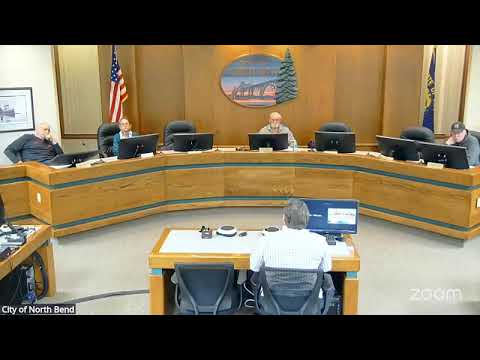
Planning commission denies appeal to convert backyard sheds into sleeping units at 190 Y Broadway
Loading...
Summary
The City of North Bend planning commission denied an appeal from property owner David Weller to convert two previously permitted storage sheds at 190 Y Broadway into sleeping units, agreeing with staff that the conversion would unlawfully expand a nonconforming residential use in the ML zone.
The City of North Bend Planning Commission voted to deny an appeal from property owner David Weller seeking to convert two permitted storage sheds at 190 Y Broadway into detached sleeping rooms.
City planner Palak Bande told the commission the property sits in a light‑industrial (ML) zone. Staff found the existing residence is a nonconforming use established before the current zoning and that converting the sheds into bedrooms would expand that nonconforming residential use, contrary to city code. "Based on these factors, staff determined that the request does not meet the applicable zoning regulation or the standard for nonconforming use," Bande said during the hearing.
Neighbors who spoke against the conversion said it would worsen safety and quality‑of‑life conditions on a narrow block. "The road is narrow. There is no parking," resident Sherry Trapp said, adding concerns about children on the street and emergency‑vehicle access. Other neighbors cited past tenant disturbances at the house, deterioration of the primary dwelling and uncertainty about plumbing and egress in the detached structures.
Applicant David Weller joined the meeting remotely and said the property had been "grandfathered" as residential and that the sheds were permitted and inspected as storage. He said the structures currently lack plumbing and utilities but are structurally convertible and that the project was intended to provide additional housing, including a potential sober‑living use. Staff and commissioners noted, however, that any sleeping units would require full building‑permit compliance, including fire‑safety and plumbing, before lawful occupancy.
After public testimony and staff answers to questions about permits and code requirements, a commissioner moved to deny case file 62725‑000020‑PLNG, finding conversion of accessory sheds into bedrooms would constitute an expansion of a nonconforming use, would not comply with ML zone regulations and would not qualify as a multifamily dwelling. Another commissioner seconded; the motion passed on a voice vote.
The decision was procedural and subject to appeal to city council. The commission closed the public‑hearing record at 7:37 p.m. and moved to its next agenda item. The applicant and neighbors were told the record and findings would be available as part of the commission's written decision.