
Menifee hearing: consultant says denser, mixed-use development raises tax productivity; council shifts focus to zoning and outreach
Get AI-powered insights, summaries, and transcripts
Subscribe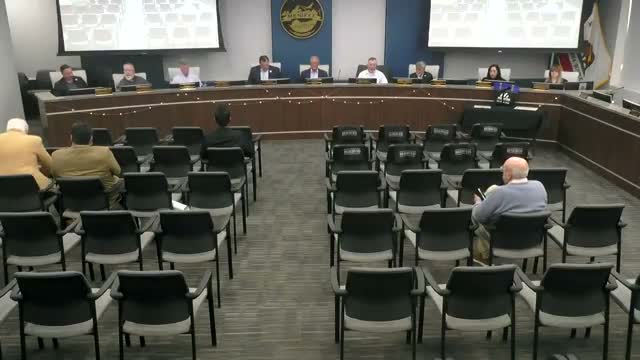
Summary
Consultant Urban3 presented a land‑use financial analysis to the Menifee City Council and Planning Commission showing denser, mixed‑use buildings produce substantially higher tax revenue per acre than large-footprint retail; officials discussed zoning, parking strategies and community education as next steps.
Menifee City Council and Planning Commissioners heard a presentation on the city’s land‑use financial analysis during a special meeting that began at 3:30 p.m., where consultant Joe Manicosi (Urban3) and Economic Development Manager Kayla Charters outlined how denser, mixed‑use development can increase tax productivity and help fund municipal services.
Charters introduced the analysis as a tool to “guide smart growth into the future,” saying the work was done “in partnership with our consultant Urban3” and framed by state mandates for planning housing. Manicosi used visual models to show tax value per acre across Menifee and peer cities, arguing that compact downtown‑style buildings and small mixed‑use properties produce far greater tax yield per acre than typical big‑box or low‑density single‑family development.
“This is just fifth‑grade math,” Manicosi told the council as he explained land value per acre: “The land is limited. As you stack stories, it’s more potent.” He contrasted a large‑footprint Walmart with ground‑floor retail and upper‑story housing, saying smaller footprints can generate many times the property‑tax and sales‑tax productivity of big‑box retail on the same acreage.
Manicosi also highlighted how state policy, including Proposition 13, affects municipal revenue: in Menifee’s current mix of tax streams, “when you put a dollar into their taxes, 13¢ of that stays at the city,” he said, noting that much of the remainder goes to special districts, the county and schools. He urged that the city weigh revenue gains from denser development against long‑term infrastructure costs such as roads and pipes.
Council and commissioners pressed for actionable next steps. Several members asked whether the analysis included a review of current zoning; Manicosi said zoning was not part of Urban3’s scope. Assistant City Manager Jones and council members discussed the Innovation District as an initial vehicle to encourage higher density and noted policy tools the city could use, including minimum building‑form standards, reduced lot‑size allowances, and shared parking structures or in‑lieu parking fees to make downtown development feasible.
Officials and staff emphasized community outreach and education. Vice Chair Holler and Commissioner Ramirez recommended targeted community meetings to explain trade‑offs between preserving rural character and creating denser nodes that can support local businesses and municipal services. Manicosi and staff offered examples from Asheville and Temecula, where public‑private partnerships (including city‑financed parking structures wrapped by housing and hotels) yielded multi‑fold tax increases after the projects matured.
Council members also raised fiscal cautions: Commissioner Knighton and others asked whether smaller‑footprint projects would require new approaches to parcel subdivision and developer incentives. Manicosi countered that form‑based rules—such as minimum story heights for downtown—and city leverage (public land or joint projects) can guide developers toward the mixed‑use configuration the city seeks.
The presentation closed with agreement to pursue follow‑up work: staff will consider how the Innovation District and potential zoning or incentive changes could be used to pilot denser development, and to plan community engagement to explain the fiscal and design trade‑offs. The special meeting adjourned at 5:03 p.m.; no votes or formal actions were taken.