
Salinas police explain complaint intake, investigation steps and new employee-recognition process
Get AI-powered insights, summaries, and transcripts
Subscribe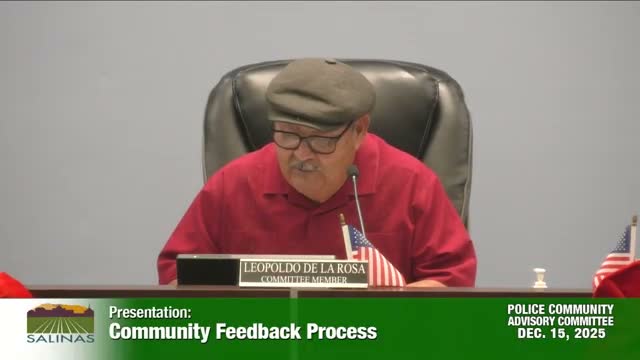
Summary
Sgt. Cameron Murphy told the Police Community Advisory Committee the Salinas Police Department distinguishes informal inquiries from formal complaints, outlined intake and internal affairs thresholds, gave 2024 disposition figures, and said commendations are now captured in personnel files and read in briefing.
Sergeant Cameron Murphy, who leads the Salinas Police Department—s professional standards work, told the Police Community Advisory Committee on Dec. 15 that the department now more clearly separates informal "inquiries" from formal "complaints" and has formalized how both are logged and handled.
Murphy said an inquiry often stems from misunderstanding and may be resolved by explaining law or procedure, while a complaint is an expression of dissatisfaction that, if supported by evidence, can trigger disciplinary steps. "A complaint is something...if proven true, could result in disciplinary action," Murphy said.
He described the intake pathway: community members may submit concerns in person, by phone or via an online form on the department website; a supervisor or patrol sergeant logs the report and it can be routed to Murphy—s office. Executive staff and the chief decide whether allegations meet the threshold for a full internal affairs investigation. "We look at evidence, we do interviews, I make a recommendation, and a finding is issued," Murphy said.
Murphy outlined possible investigative dispositions used by the department: sustained (enough evidence to prove the allegation), not sustained (insufficient evidence), exonerated (incident occurred but was lawful and within policy), unfounded (allegation is not factual or did not involve department personnel), or withdrawn (the complainant retracts the complaint). He said personnel-file details are constrained by law but that the complainant is notified of the outcome.
On complaint volumes, Murphy reported that in 2024 the department documented three internally generated complaints and about 20 community-originated complaints; dispositions recorded at the time included two sustained, three not sustained, nine exonerated, seven unfounded, one ongoing and one withdrawn.
The department also set up a formal commendation process so positive feedback is preserved and routed into an employee—s personnel record and briefings. "We set it up in a way so that now there's documentation and we're gonna make sure that those good things get into an employee's file just like when they get corrective action taken," Murphy said.
Committee members asked about timelines and transparency. Murphy said there is no strict deadline for submitting commendations and that policy updates come from a contracted service, Lexipol, which issues best-practice templates and legal updates; the department adapts those to local needs and reviews them with the city attorney. He confirmed that demographic information captured on complaint forms is not published in full in every annual report but can be obtained through a Public Records Act request and is reported to the state.
Murphy also described hiring and background checks for lateral officers: prior-agency personnel files and internal affairs history are reviewed during vetting; some records are retained by human resources under the city's retention policy.
The presentation concluded without formal action; committee members thanked Murphy and offered suggestions on public-facing recognition and outreach.