Get Full Government Meeting Transcripts, Videos, & Alerts Forever!
Get email alerts on the Traffic Safety topic
No spam. Unsubscribe anytime.
Livermore presents Vision 0 action‑plan draft after five‑year collision review
Summary
City of Livermore staff and consultants outlined a Vision 0 action plan, reported 833 injury collisions (57 KSI) from 2020–2024, identified 13 high‑injury corridors, and launched an interactive website and map tool to gather community input ahead of council adoption.
City of Livermore staff and their transportation consultants on the outreach team presented a draft Vision 0 action plan and five‑year collision analysis, saying the plan will prioritize safety countermeasures and community input before the city takes the document to council for adoption.
"There should be zero traffic fatalities and severe injuries," said Ruta Jarivala, project manager at TGCam Transportation Consultants, summarizing the Vision 0 goal and safe‑system principles that guided the presentation. Jarivala said the plan uses both reactive, data‑driven collision analysis and proactive community engagement to develop a prioritized, implementable action list.
The presenters said the five‑year data set (2020–2024) shows 833 injury collisions across the city, of which 57 were counted as KSI — killed and severe injury collisions — and that annual KSI totals were 11 in 2020, 12 in 2021, 8 in 2022, 16 in 2023 and 10 in 2024. Jarivala said those KSI incidents will be the main focus of proposed countermeasures.
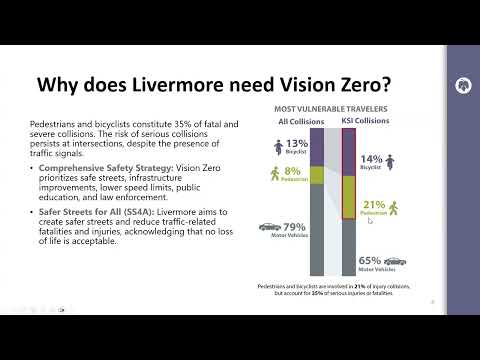
Mode and location breakdowns were highlighted to guide interventions: for all injury collisions, passenger vehicles were involved in roughly 71% of incidents, with bicyclists about 13% and pedestrians about 8%. For KSI collisions specifically, the team reported passenger vehicles at 40%, motorcycles 23%, bicycles 14% and pedestrians 21%. The presentation noted that 75% of KSI collisions (43 incidents) occurred at intersections and 25% (14 incidents) occurred on roadway segments.
Jarivala identified leading violation categories that contributed to collisions as DUI (19%), unsafe speed (19%), automobile right‑of‑way violations (16%) and improper turning (11%). Collision type breakdowns put broadside crashes at about 26% and vehicle‑to‑pedestrian collisions at about 21% of the dataset. The team also reported lighting findings (70% of collisions in daylight, 22% at night with street lights present, 4% in dark locations without functioning street lights) and age bands most frequently at fault (drivers aged 20–29 accounted for 26% of at‑fault cases).
To prioritize work, presenters said they identified 13 high‑injury corridors that together accounted for seven fatal and 30 severe injuries in the five‑year window. The top three corridors listed in the meeting materials were Vasco Road (Scenic Avenue to West Gate Drive), 1st Street (I‑580 to B Street) and, as listed in the transcript materials, "Air Bridal Boulevard" (Sutter to Kitty Hawk Road). The presenters noted they will consider the entire city for policy or network changes but will use the corridor list to sequence near-term projects.
The outreach component includes a project website and an interactive map input platform (transcript link shown as "mapshner.com"), where residents can answer a short survey, pin specific locations or draw corridors to flag safety concerns. Jarivala demonstrated pinning an intersection and suggested users describe the change they want, such as a high‑visibility crosswalk or a leading pedestrian interval. The team encouraged repeated submissions and said name and email are optional when leaving comments.
Jarivala said the Vision 0 report and action plan are prerequisites for applying to certain safety grants mentioned in the presentation (transcript references included "ATSIP, OBAC, Safe Streets for All") and that the draft plan must be adopted by council before the city pursues those funding opportunities. The team listed next outreach meetings on January 28 and February 25 and invited further comment before preparing a draft report for council consideration.
The meeting closed with an open Q&A; no formal motion or vote was recorded during the session. The project team said they will incorporate community feedback into collision profiles, identify engineering and non‑engineering strategies and return with a prioritized safety project and action list for review before taking the plan to the City Council for adoption.