Get Full Government Meeting Transcripts, Videos, & Alerts Forever!
Get email alerts on the Civil Service Lists topic
No spam. Unsubscribe anytime.
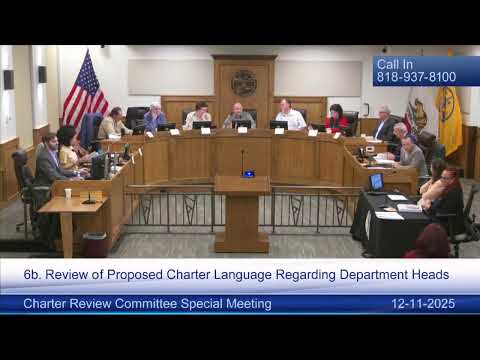
Charter panel debates eligibility-list limits, the "rule of three" and probation periods
Summary
The Glendale Charter Review Committee spent the Dec. 11 meeting reviewing proposed changes to civil-service language, including two alternatives for eligibility-list duration, whether to keep the "rule of three" for cancelling lists, and whether to bifurcate rules for sworn (police/fire) and civilian jobs; members asked staff and unions for more concrete guardrails and will continue in January.
Chair Flower and staff opened a lengthy review of proposed red-line changes to the charter's civil service provisions (Article 24) at the committee's Dec. 11 meeting, focusing on three interrelated issues: how long names remain on eligibility lists, whether the charter should retain the so-called "rule of three" for cancelling lists, and appropriate probation periods for different job types.
Staff presented two alternatives: Alternative 1 would remove a hard ceiling (currently not longer than two years) and defer the length of eligibility lists to rules adopted by the Civil Service Commission (giving that body more discretion); Alternative 2 would preserve a charter floor and ceiling (for example, not less than one year and not more than two years) while keeping cancellations tied to the existing rule that lists may be cancelled only when three or fewer candidates remain.
Bargaining representatives (including Sean Toro, president of the Glendale City Employees Association, and Pete Robinson, a Glendale PD lieutenant speaking for police associations) told the committee they are still developing formal written positions and asked for more time to consult members and legal counsel. Robinson and other public-safety representatives urged carve-outs for sworn positions, noting life-safety implications of lengthening or shortening lists and of changing probation or promotion rules.
Key points from staff and members:
- Staff (Paula Adams, HR) explained that sworn positions and civilian positions operate differently in practice: sworn job classifications typically rely on orderly promotion lists and are administered with more rigid expectations, while some civilian roles (IT, project management) may require shorter lists because skills change rapidly.
- Several committee members said they favor a bifurcated approach that would keep 1-to-2-year guardrails for sworn public-safety jobs but allow more flexibility for civilian classifications through rules adopted by the Civil Service Commission and subject to council approval.
- The committee discussed replacing the strict "three-name" cancellation standard with a "good cause" rule that would be defined prospectively (for each list) so applicants know up-front the conditions under which a list could be cancelled.
Why it matters: Eligibility-list length, cancellation rules and probation periods affect hiring speed, applicant expectations and department operations. Shorter lists can reduce time-to-hire for fast-moving technical roles but risk disrupting long-standing promotion expectations in public safety.
Outcome and next steps: No decisions were finalized. The committee asked bargaining groups to submit written proposals before the January meeting and asked staff and the city attorney to draft potential guardrails (including prospective definitions of "good cause") to present in January.
Quoted: "It would force the HR department ... in collaboration with department heads and our unions to determine upfront what length of time we collectively believe is good for different jobs," HR staff member Paula Adams said, describing how rule changes could be tailored by classification.
The committee recessed and agreed to continue Article 24 discussions in January.