Get Full Government Meeting Transcripts, Videos, & Alerts Forever!
Get email alerts on the Budget Reserves topic
No spam. Unsubscribe anytime.
Finance Commission approves capital stabilization policy with $100,000 use threshold
Summary
The Norwood Finance Commission approved the capital stabilization fund policy (version dated 11/20/2025), endorsing a $100,000 threshold for allowable uses after discussion of inconsistencies in draft language and school committee concerns about lower-cost school items.
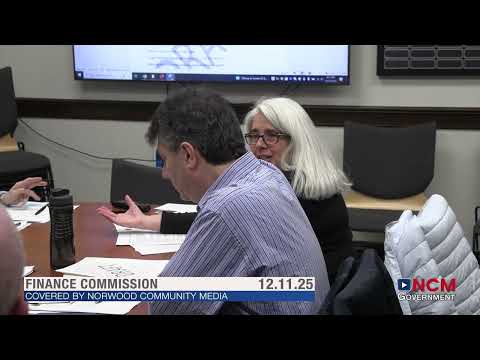
The Finance Commission of the Town of Norwood voted Dec. 11 to approve the capital stabilization fund policy, adopting the draft dated Nov. 20, 2025, and confirming a $100,000 threshold for uses of the stabilization fund.
Commissioners spent the bulk of the discussion on how the policy defines "capital." Eric (Speaker 3), who represented the commission at a recent school committee meeting, said the school committee raised concerns that many school IT and other school projects fall below a $50,000 cutoff in an earlier draft. Eric said a review of the five-year capital plan identified several smaller projects — a helipad upgrade listed at $17,500, certain masonry repairs, Civic Center air-conditioning work and DPW vehicle purchases — that would fall under that lower figure.
Several commissioners said the operative limit in the policy text should be aligned across documents. Commissioners noted multiple draft versions circulated previously that referenced $50,000, $100,000 and even $200,000 in different places. The chair said the Board of Selectmen had already approved the Nov. 20 draft and that the version the commission moved to adopt included the $100,000 threshold.
Speaker 4 and Speaker 5 urged that the policy include a clear definition of what constitutes a capital item; others argued that the policy could instead defer to a single operating definition used in the capital improvement policy. Commissioners discussed whether routine, recurring costs (for example, an annual lease) should be treated as operating expenses rather than capital investments, and they recommended that smaller, repeated expenditures be funded from operating budgets or consolidated into larger projects where appropriate.
Eric moved to approve the capital stabilization fund policy (version dated 11/20/2025); Speaker 2 seconded the motion. The commission approved the motion by voice vote with no opposition recorded. The chair asked staff to prepare and send a letter to the town manager's office documenting the action and requesting coordination with other boards.
Next steps: commissioners said they would report the commission's action back to the school committee (Eric offered to attend an upcoming school committee meeting) and asked staff to ensure the policy language is consistent with the capital improvement policy and other financial documents.
Sources: Discussion and vote during the Dec. 11, 2025 Finance Commission meeting.