Olmsted County adopts 2026–2030 capital improvement plan and authorizes bond issuance
Loading...
Summary
The Olmsted County Board adopted a $2026 capital improvement plan authorizing bond issuance and designating transportation sales-tax projects, identifying major projects including the Trunk Highway 14 & 44 interchange and a material recovery facility and estimating $461 million of projects over five years.
Olmsted County commissioners on [date not specified] adopted the county’s 2026 capital improvement plan (CIP), authorized related bond issuance and formally designated projects eligible for the county’s transportation local-option sales tax.
Kami Iverson, the county’s physical development controller, described the CIP as a “multi-year planning tool” and a roadmap that establishes the capital budget for the first year while listing planned projects for years two through five. Iverson told the board the packet proposes roughly $115,000,000 of CIP projects for 2026 and about $345,000,000 of projects proposed for 2027–2030, for a five-year planning total of roughly $461,000,000.
Major projects highlighted in the presentation included the Trunk Highway 14 and 44 interchange, a material recovery facility (MRF) and an exhibition center. Iverson said some projects in years two through five remain planning estimates and that about $21,000,000 of items are included in the plan as currently unfunded.
On funding, Iverson laid out multiple revenue sources in the packet: an estimated $107,000,000 from wheelage or local sales sources over five years, about $137,000,000 in anticipated state and federal funds, and roughly $124,000,000 in debt financing (figures presented as estimates). She told the board the 2026 debt estimate was about $16,600,000 and that, if all projects proceed as proposed, the county would add approximately $3,200,000 in new annual debt-service costs; she said portions of that would be covered by levy funds, ROIHA support for a specific project and the solid waste fund.
Board members asked timing questions about bond sales and whether the full $44,500,000 of authorized bonding would be sold immediately. Iverson said the county typically times issuance to cash needs and often sells bonds in the fall to match project schedules and bid results.
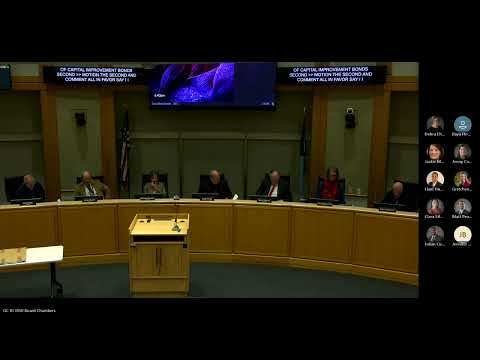
The chair opened and closed a public hearing on the CIP after calling for speakers three times; no members of the public testified. A motion to adopt the proposed resolution authorizing sale of capital improvement bonds was seconded and approved by the board.
The board’s approval formalizes the county’s capital priorities for 2026 and sets the authorization the county can use to issue bonds as projects proceed. The CIP presentation packet and the board discussion noted that years two through five are planning-level estimates and that scope, schedule and funding may change as projects advance.