
Presiding judge handles crowded 187th District docket: GPS monitoring ordered, multiple revocations and sentences imposed
Get AI-powered insights, summaries, and transcripts
Subscribe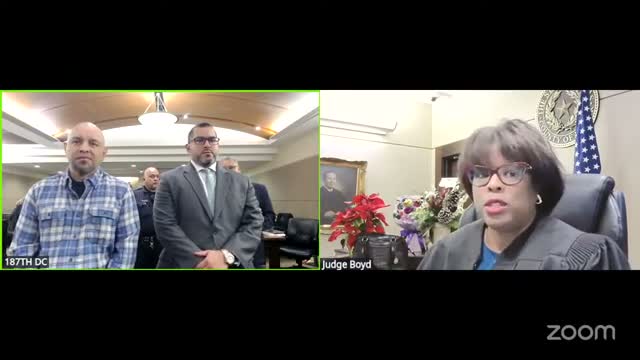
Summary
The presiding judge conducted a heavy docket Dec. 18, ordering GPS tracking for a defendant, revoking supervision and imposing jail sentences in multiple cases, accepting several plea agreements, and setting final discovery and trial dates for others.
The presiding judge in the 187th District Court on Dec. 18 moved through a packed docket of pleas, revocation hearings and scheduling matters, ordering electronic monitoring in one case and revoking supervision with jail time in others while pressing attorneys to resolve outstanding discovery.
Among the day's formal rulings, the court found a violation of supervision true in cause number 2017CR13698 and revoked Adriana Tanahara's community supervision. The judge sentenced Tanahara to one year in a state jail facility, ordered restitution to HEB in the amount of $743.99 and prohibited unsupervised contact with minors, and requested placement in a therapeutic community program.
The court also resolved a motion to revoke for Amani Renee Robinson after the state alleged months of missed reporting. The judge revoked Robinson's supervision and sent her to 300 days in the county jail under the applicable statutory provision, while placing no-contact and other standard conditions on the record.
In another hearing, the judge accepted a plea and sentenced Randy Gonzales to 180 days in the Bexar County jail and imposed an $800 fine; the court ordered his time and fines to run concurrent with related matters and imposed a restriction against residing in households with minors. The court likewise accepted a plea in the matter of William Hink and sentenced him to 160 days and restitution of $740.43 to Watershed Car Wash.
Separately, after probation reported that a defendant who completed in‑custody stabilization (ISF) had been evaluated, the court ordered GPS tracking only (no curfew), waived monitoring fees and directed that the device be fitted no later than the coming Friday; the judge said the court would review removal of the condition after a period of compliance.
The bench emphasized process and scheduling: the judge repeatedly required discovery acknowledgments, set multiple plea-deadline and jury trial dates in January through March for cases that remain unresolved, and instructed counsel to approach the clerk to file motions and reset forms where needed.
The judge closed the morning calendar for a jury trial to begin at 1:30 p.m., leaving several cases continued to specific plea or jury-dates and directing deputies to ensure in-custody defendants were produced as required.
The decisions recorded in court were all made on the record; court staff and counsel were instructed to file necessary forms and return on the dates the court set.