
Tracy council reviews five draft district maps, narrows focus to three and sets January adoption timeline
Get AI-powered insights, summaries, and transcripts
Subscribe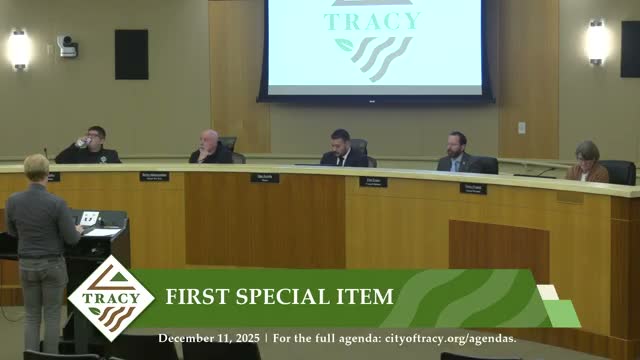
Summary
At a special meeting, Tracy council heard a presentation of five consultant-drawn draft maps and public-submitted plans, heard residents ask for more outreach and workshops, and directed staff to revise variants of three maps (green, blue, orange) ahead of a Jan. 13 workshop and potential ordinance introduction Jan. 20.
The Tracy City Council on the evening of the special workshop heard demographic consultant Michael Wagman present five draft district maps and multiple public-submitted plans as the city moves toward district-based council elections. Wagman said his role was neutral: “I have no skin in this game,” and demonstrated interactive mapping software that allows live line-drawing for tweaks.
Why it matters: The council must choose a map that balances legal requirements, communities of interest and population equality under the 2020 Census while preserving recognized neighborhoods. Staff told the council revised maps will be published by Jan. 6, 2026, with a refinement hearing on Jan. 13 and potential ordinance introduction and map adoption on Jan. 20, followed by a second reading in February.
Wagman explained the logic behind each draft. The green plan prioritizes age of the housing stock and keeps older neighborhoods together; the blue plan follows Tracy Unified elementary enrollment zones to minimize school splits; the purple plan uses major streets as boundaries; the red plan aims to account for rapid population growth in southern areas by underdrawing two districts; and the orange plan creates an east–west District 3 tied to the rail line. Wagman cautioned each plan requires trade-offs and said no map is final.
Public outreach and participation were central to staff remarks. City Clerk April Quintanilla summarized outreach efforts, saying an email announcement was “sent to 17,971 email addresses, including those for community organizations with a 62% open rate,” and that consultants placed 86 calls to community organizations. Paper copies of maps are available at the clerk’s office and staff will attend the farmers market on Jan. 10 and host the next hearing on Jan. 13 at 7 p.m.
Residents at the meeting urged more time and hands-on workshops. Robert Tanner urged inclusion of Tracy Hills and warned that district-based representation can shift focus to parochial interests, citing Stockton as a cautionary example. Multiple speakers asked for community workshops, more notice for nonprofit organizations and clearer printed maps; an online participant said the presenter moved “really fast” and reported some community members were confused by colors and labels.
Council members then offered initial preferences and concerns. Several members said they prefer the green or orange plans for clearer neighborhood cohesion; others favored the blue plan for school-zone alignment. Multiple members objected to plans that appear to split downtown and Edgewood (notably the red plan) or that separate industrial areas in ways they found less logical (purple). Wagman summarized the discussion and said the council’s direction centered on green, blue and orange variants; he will produce revised variants for the January hearings.
Formal actions taken that relate to the meeting process included reopening public comment briefly to allow an online speaker, a motion that passed, and a final motion to adjourn that passed by roll call. Staff confirmed revised maps and materials will be posted on the districting web page and included in the Jan. 13 agenda packet.
What’s next: Staff will post revised map variants (at least three) by Jan. 6, hold an on-record workshop Jan. 13 for refinements, and, if consensus emerges, bring a resolution and ordinance introduction to the council on Jan. 20 with a second reading in February.