"Jefferson Rising": district proposes sunsetting dual assignment and expanding Jefferson into a comprehensive high school; public comment raises boundary, pace,
Loading...
Summary
District staff recommended ending Jefferson High School’s dual assignment overlay and investing to expand academic and athletic programming during a 2026 modernization; public commenters from Sabin and Irvington urged the board to reconsider proposed feeder changes and to prioritize stability, transportation and equity for impacted students.
Assistant Superintendent Margaret Calvert and senior director Philip Hristich presented the superintendent’s recommendation to sunset Jefferson High School’s dual assignment overlay and transition Jefferson into a comprehensive neighborhood high school aligned with a 2026 modernization.
Calvert said the proposal seeks to "grow and stabilize enrollment at Jefferson," restore neighborhood access across North/Northeast Portland, and invest in four core pillars—coherent college preparatory pathways (including AP/dual‑credit sequencing), career‑technical education aligned to regional high‑wage sectors, a strengthened visual and performing arts program, and a partner‑supported learning ecosystem with expanded post‑secondary and industry connections.
The recommendation includes a phased investment of at least two additional FTEs during phase‑in years (beginning 2026) and a program‑development budget for training and staff development through 2030. Staff described an engagement timeline through 2026–27, with further forecasting for 2027–28 and enrollment modeling tied to modernization and boundaries.
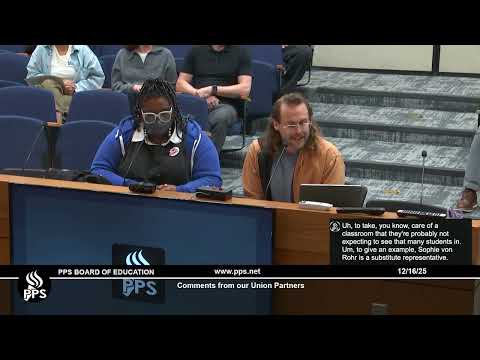
During a lengthy board Q&A and public comment period, neighborhood representatives urged refinements to the preferred scenario. Sabin parents and advocates said scenario C as published would reassign Sabin away from Grant, risk unsafe or impractical travel routes to Jefferson, and fail to reflect community feedback; they asked the board to add Sabin back to the scenario or delay boundary changes until after Jefferson’s rebuild. Other community speakers argued scenario C best balances utilization across the four impacted high schools and that outreach should focus on affected communities.
Board members asked for additional clarifications: enrollment projection methodology (district staff said projections model internal PPS student progression and are not a simple neighborhood capture rate), assumptions about students opting to attend Benson and other focus programs, utilization targets (staff said scenario C would bring high schools into a ~70–90% utilization range), and monitoring and amendment language for the January resolution.
What happens next: Superintendent Armstrong will present a resolution in January to end the dual assignment overlay; the board may accept the recommendation, propose amendments, or choose an alternate scenario. Staff said they will provide a history of the dual assignment policy, revised FAQs, PDFs of materials, clearer projection definitions and monitoring language to accompany the resolution.
Ending note: the board scheduled the formal vote in January and asked staff to supply the resolution text, historical context and monitoring commitments in advance so members and the public can review any proposed amendments.