Portland substitutes urge district to restore incentive pay and fix Frontline app
Loading...
Summary
Substitute teachers told the Portland Public Schools board that district teaching‑position cuts have reduced substitute assignments about 20%, putting many substitutes at risk of falling short of the 55‑day threshold needed for health benefits. The union urged reinstating incentive pay and restoring Frontline filters, and raised equity concerns about paid third‑party apps.
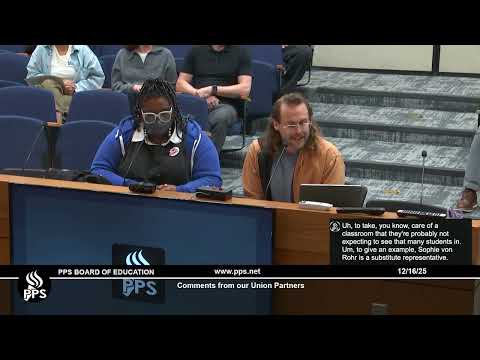
Ian Mullen, chair of the Portland Association of Teachers’ substitute committee, told the Portland Public Schools board during public comment that recent staffing cuts and the removal of incentive pay have dramatically reduced substitute work and threatened substitutes’ access to employer‑sponsored health insurance.
“From data that we’ve received from the district, we are on pace for about 50,000 jobs,” Mullen said. “That’s about a 20% decrease” from an earlier level he described as roughly 65,000 annual assignments, a drop he said threatens many substitutes’ ability to meet the 55‑day eligibility benchmark for health benefits.
The union asked the district to reinstate incentive pay that had previously been offered to substitutes working at historically hard‑to‑fill schools. Mullen said incentive rates were roughly $50 a day (and $35 for a half day) before 2022, were cut to about $15 (and $10 for a half day), and that the reduction correlated with falling fill rates at named schools.
Mullen also described problems with Frontline, the district’s absence management system. He said that Frontline was recently reconfigured in a way that removed persistent certificate‑based filters for substitutes, leaving many substitutes unable to see assignments that match their credentials. That change, he said, combined with the rise of subscription third‑party apps such as SubAlert that refresh listings faster, has created a de‑facto pay‑to‑play market for assignments.
“We know that those third party apps…can refresh sometimes as much as 6 minutes faster than Frontline, and this gives paying subscribers an advantage,” Mullen said, urging the district either to reinstate filtering options in Frontline, enforce its acceptable‑use policy for third‑party services, or provide stipends to cover subscriptions.
District and union leaders on the dais confirmed they are exchanging information and said they will continue discussions. Board members praised the unions’ public testimony and asked staff to follow up with data about fill rates, the incentives program history, and alternatives for ensuring equitable access to substitute assignments.
What happens next: the board did not take a formal vote on the union’s requests at the work session. Union leaders said they expect staff follow‑up and asked the district to act ‘‘in short order’’ either by restoring filters, reinstating incentive payments, or covering the cost of third‑party services.
Ending note: the issue was raised as part of broader conversation about budget pressures, and board members signaled they expect follow‑up information to inform bargaining and budget planning in the months ahead.