Get Full Government Meeting Transcripts, Videos, & Alerts Forever!
Get email alerts on the Parking topic
No spam. Unsubscribe anytime.
Kimley‑Horn tells McHenry council downtown has enough spaces but needs clearer signage, targeted 2‑hour limits
Summary
A Kimley‑Horn presentation to the McHenry City Council on Dec. 1 recommended targeted 2‑hour time limits on high‑demand blocks, clearer wayfinding and signage, stronger enforcement with license‑plate recognition and pedestrian connections to underused lots.
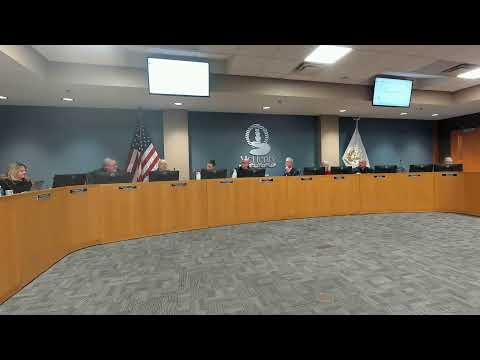
McHenry — The city’s downtown likely has enough overall parking, but drivers cluster in a few high‑demand blocks and the city can improve turnover and access with better signage and targeted time limits, a consultant told the McHenry City Council at its Dec. 1 meeting.
Peter Lehi of Kimley‑Horn, who presented the firm’s downtown parking study, said consultants surveyed public spaces on four busy dates (May 2, May 17, June 20 and Aug. 2), used hourly drone counts on peak days and measured turnover on core blocks. The firm found peak evening utilization reached 80–90% on Riverside Drive and portions of Green Street and that average parking durations were about 1.7–1.9 hours.
"How do we support our downtown businesses? How do we make Downtown McHenry a place that is attractive?" Lehi asked as he framed the study’s goals. For a conceptual Green Street redevelopment (125 residential units, 5,000 square feet of retail and 15,000 square feet of restaurant), Kimley‑Horn estimated the development and displaced demand would require about 411 parking spaces after applying a 10% buffer.
Lehi recommended several near‑term steps: change high‑demand stretches on Riverside and Green Street from 4‑hour to 2‑hour limits to increase turnover; clarify permit‑parking signage (for example, add a placard reading "permit holders accepted" rather than signs that read "permit only"); install consistent wayfinding or monument signs for public lots; and investigate targeted enforcement using license‑plate recognition (LPR) to improve compliance.
"We wanted to provide a recommendation of a 2‑hour parking for those stretches," Lehi said, noting most trips observed fit that duration.
Council members pressed on trade‑offs and implementation. Alderman Miller said signage should be the first priority: "I think signage is is our biggest concern," she said, adding that many visitors are willing to walk an extra block if pedestrian routes feel safe and visible. Lehi and other staff also urged improving pedestrian connections and lighting between underused lots and Green Street storefronts to expand the effective walking radius from available spaces.
City staff said they will follow up with specific next steps: confirm ownership and clarify signage on lots currently labeled "private," add lot addresses and listings in mapping services, pilot updated signage, and pursue outreach with downtown businesses before any ordinance changes. The council directed staff to pursue signage and wayfinding and to return with implementation details and cost estimates.
The study team cautioned that special events (for example, sellout shows at the Vixen or parades) produce different peak patterns; repeated high peaks could require capacity additions rather than regulation changes. For now, the consultants and staff said the combination of clearer signs, improved pedestrian connections and targeted enforcement should increase turnover and reduce the perception of scarcity without immediately adding paid parking.
Next steps: staff will coordinate business outreach on proposed 2‑hour segments, confirm lot ownership and signage fixes, post lot addresses to mapping services, and report back to council with cost and timing recommendations.