Get Full Government Meeting Transcripts, Videos, & Alerts Forever!
Get email alerts on the Land Use Healthcare topic
No spam. Unsubscribe anytime.
Delray planning board continues controversial 24‑hour freestanding ER after heavy neighborhood opposition
Summary
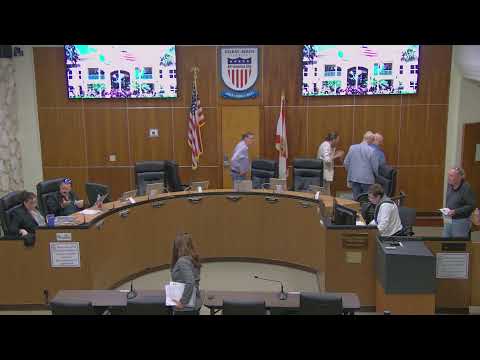
After hours of public comment and questions from board members, the Delray Beach Planning & Zoning Board voted 6–1 to continue a request to allow 24‑hour operation for a proposed freestanding emergency department at 3921 W. Atlantic Ave. The applicant agreed to meet neighbors during the pause.
The Delray Beach Planning & Zoning Board on Dec. 15 voted 6–1 to continue to Feb. 23 a conditional‑use request that would allow a 24‑hour freestanding emergency department (FSED) on a 1.79‑acre vacant parcel at 3921 West Atlantic Avenue.
John Roach, a certified urban planner with Gunster representing JFK Medical Center Limited Partnership, told the board the project would place an approximately 10,800‑square‑foot freestanding emergency department along West Atlantic, with an ambulance bay on the north side and landscaping and buffers to shield nearby homes. Roach said the developer expects the facility to generate about 17 PM peak‑hour trips and about “1.1 to 1.2 ambulances per day,” figures he said were drawn from operating FSED data.
Neighbors and community representatives urged the board to deny the 24‑hour portion of the use or to impose strict conditions. Andrew Sparenzini, counsel for High Point of Delray Beach Section 1, said roughly 25 residents attended in opposition and asked the board either to deny the application or require “maximum landscaping for noise and light buffering” including fully mature canopy trees and an 8‑foot hedge. Sparenzini also argued the LDR requires the filing of a security plan for 24‑hour uses and urged staff to enforce that requirement.
Local medical leaders also weighed in. Dr. Eric Lieberman, a Delray cardiologist, said placing an FSED a few miles from a comprehensive hospital risks confusing patients and delaying treatment for time‑sensitive conditions. “Heart time is muscle, time is brain,” he said, stressing that some interventions cannot be performed at an FSED and require transfer.
Heather Haberchak, CEO of Delray Medical Center, disputed claims that the hospital is overcrowded and said the hospital averages rapid evaluation times, citing internal measures: “When a patient comes to Delray Medical Center’s emergency department, from the time they walk in the door, on average, they see a provider within 12.7 minutes,” she said. Haberchak warned adding a nearby FSED could create patient and EMS routing confusion in an area that serves an older population.
Applicant counsel Brian Seymour said the ambulance estimate is statistical, not a guess, and offered to meet with High Point leaders to refine buffering and mitigation measures. He told the board the applicant was willing to discuss orientation changes, additional landscaping, and lighting controls to reduce impacts.
Board members pressed staff and the applicant to clarify scope: the board is being asked only to approve the 24‑hour/late‑night portion of a medical office use that is otherwise permitted by right. Several members said the 24‑hour portion could have material neighborhood impacts even if medical office use is allowed during daytime hours. Given outstanding findings staff needed to include in the record and the neighborhood’s concerns, the board agreed to continue to a date certain so the applicant and staff can refine proposed conditions and buffering.
On the motion to continue, Price Patton moved and Judy Malika seconded; the board recorded a 6–1 vote in favor, with Jim Chard the lone dissent. The applicant and neighbors were advised to meet before the Feb. 23 hearing; staff said the continuation gives time to produce the level‑2 site plan findings and any recommended conditions the board may consider.
Next steps: The board’s action was a procedural continuance, not an approval. The matter will return to the Planning & Zoning Board on Feb. 23, when the board will consider any additional findings, conditions and the public record produced in the interim.