Get Full Government Meeting Transcripts, Videos, & Alerts Forever!
Get email alerts on the Rezoning topic
No spam. Unsubscribe anytime.
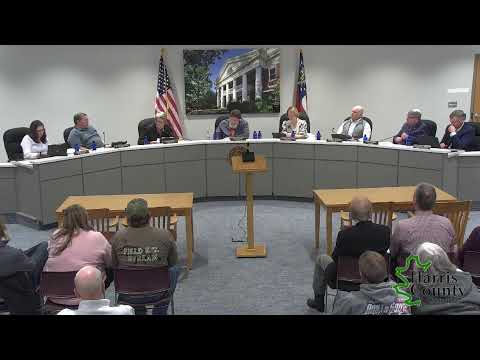
Harris County commissioners deny rezoning for proposed 135‑acre subdivision near Veterans Parkway
Summary
After more than two hours of testimony and questioning about sewer, traffic and quarry risks, the Harris County Commission voted Dec. 2 to deny a developer’s request to rezone roughly 134.93 acres from R‑1 to R‑2 for what the applicant said would be about 86 homes. Residents cited sewer capacity, traffic safety and blasting risks as reasons to reject the change.
HARRIS COUNTY, Ga. — The Harris County Commission voted Dec. 2 to deny a request by landowner Will White to rezone about 134.93 acres near the intersection of Veterans Parkway and Grama Rock Road from R‑1 (low‑density residential) to R‑2 (medium‑density). The motion to deny carried after extensive public comment focusing on sewer service, traffic safety and potential damage from an adjacent quarry.
The applicant’s representative, Anthony Swaddle of Noon Mix and Associates, told the commission the R‑2 designation would allow up to 134 lots but that the owner was seeking permission to design “around 86 lots.” Swaddle said bringing sanitary sewer to the subdivision would allow more flexible siting of houses, reduce septic failures and — he asserted — could be designed as a gravity‑fed system to tie into the Columbus Water Works system. “We’re only asking for the opportunity to design a subdivision with around 86 lots,” Swaddle said in his presentation.
Opponents disputed several of the developer’s technical claims and urged the commission to withhold approval until written agreements and detailed plans were produced. Neighbors and former engineers cited conflicting statements about where sewer lines would tie in and whether Columbus Water Works had agreed to accept additional sewage. “Traffic on Grey Rock Road at the intersection with Veterans Parkway has become increasingly dangerous,” resident Myra McMillan said, urging commissioners to protect public safety during peak hours. Retired GDOT civil engineer Bobby Watson told the board he had been told Columbus would not take additional sewage at present and said planned DOT roundabouts referenced in earlier materials had been cut when federal funds were lost.
Several residents raised the quarry adjacent to the property as a specific safety and property‑value concern. Chuck Hunsaker said earlier blasting had damaged tile floors in his home and warned new houses built close to the quarry could sustain similar damage in the future. Residents also urged enforceable written commitments rather than verbal assurances; John Mitchell asked the commission to require specific, written conditions if any rezoning were approved, including minimum house sizes, turn‑lane construction at entrances and a formal sewer acceptance agreement with Columbus Water Works.
The planning commission had previously recommended approval with conditions (reported as a 6–1 vote in the record). Swaddle acknowledged that no signed agreement existed with Columbus Water Works at the time of the hearing but said preliminary conversations with Water Works leadership indicated a willingness to discuss service once the rezoning advanced. He told commissioners he planned design work only after securing rezoning approval.
Commission discussion before the vote addressed fiscal implications and the county’s long‑term infrastructure needs. One commissioner framed the request against the county’s operating budget and revenue mix, arguing medium‑density development could strengthen the tax base without immediately raising millage rates. Opponents countered that the county’s wastewater operations lacked staffing and capital to absorb expanded service without external agreements or costs passing to taxpayers.
After deliberation, a motion to deny the rezoning was made and seconded. The chairman announced, “Motion carries. It is denied.”
What’s next: The developer retains the right to make future applications consistent with the county’s Unified Development Code; several residents and commissioners noted that a future commission could hear a new or amended application. The county did not record any formal, signed agreement with Columbus Water Works during the hearing; residents asked the commission to require such confirmations and enforceable conditions before any similar proposal moves forward.