Get Full Government Meeting Transcripts, Videos, & Alerts Forever!
Get email alerts on the Infrastructure Development Districts topic
No spam. Unsubscribe anytime.
Franklin board debates new Infrastructure Development District policy after hours of questions on homeowner costs and protections
Summary
Board of Mayor and Aldermen held an extended review of draft Infrastructure Development District (IDD) policies, pressing staff and consultants on how bonds, holdbacks and special assessments would affect buyers and whether the tool will deliver municipal benefits without shifting risk to residents. Staff will revise the policy and return in January.
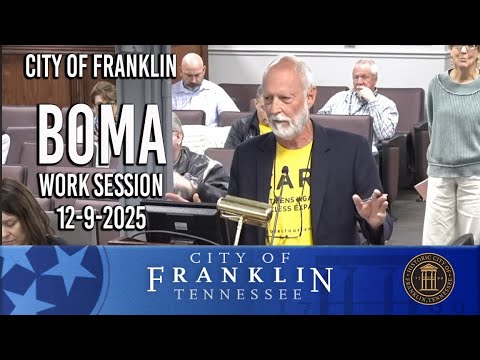
Franklin — The Board of Mayor and Aldermen spent the bulk of its Dec. 9 work session debating a proposed policy to govern Infrastructure Development Districts, an emerging financing tool that staff say can fund ‘exceptional’ infrastructure and redevelopment while keeping existing taxpayers from covering new development costs.
The draft policy, presented by city staff and consultants, would align IDD petitions with the normal development-plan process and requires applicants to specify municipal benefits such as enhanced intersections, infrastructure beyond developer requirements, attainable housing or redevelopment. Vernon, a city consultant, said developers would submit a notice of intent concurrently with a development plan and that a final petition would come forward for public hearing and board consideration once civil drawings make project costs clearer.
Why it matters: Aldermen and residents raised concrete concerns about how IDDs impose special assessments on property owners within a district. Alderman Peterson cited examples from other jurisdictions showing significantly higher annual assessments for homeowners and asked whether buyers might be unaware of large long-term costs. Staff and consultants repeatedly clarified that an IDD assessment is a special assessment collected alongside property taxes — “not a property tax,” staff said — but acknowledged it will "look and feel" similar on a resident’s annual bill.
Key technical tradeoffs were contested. Betsy Knotts (Basbury), who advised on financing, described holdback structures used elsewhere: a conservative approach releases funds only after completion and inspection, while a middle-ground option pays an upfront portion and releases more at performance milestones. She noted federal tax rules often require bond proceeds to be spent within three years, a constraint that shapes deal timetables. Board members sought assurance that milestone releases and bond documents would include performance protections and that the city would retain authority to withhold funds until work met agreed standards.
Opposition and risk concerns surfaced during public comment. Several residents and community speakers described national cases where special-district debt left homeowners with heavy assessments or communities with unfinished amenities. Patrick Collins and others warned of developer-driven debt and asked who would be liable in case of default. In response, proponents on the board argued IDDs give the city an additional tool so "new growth pays for itself," potentially financing projects that would otherwise not be feasible and preserving existing taxpayers from covering those costs.
Board direction and next steps: Staff told the board they would update the draft policy to add clearer language on the approval timing (syncing the IDD vote with development-plan consideration), provide guidance on holdback/milestone structures, and strengthen transparency requirements for disclosure to potential buyers. Staff committed to return a revised draft at a January work session and then schedule a voting session if the board is comfortable.
The board did not take a vote on the policy at the Dec. 9 meeting. The work session concluded after public comment and staff said they will bring a revised draft back to the board for further review in January.