
Boston council committee hears annual tax-classification order; council to vote Wednesday on 35% residential exemption
Get AI-powered insights, summaries, and transcripts
Subscribe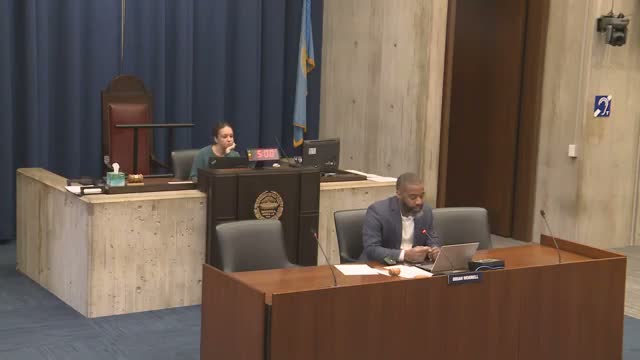
Summary
The Boston City Council Ways and Means committee held a hearing on docket 2045 — the annual order to set tax classification and a 35% residential exemption for FY2026 — with city officials urging timely action to avoid a default flat tax rate and councilors pressing on neighborhood impacts and budget trade-offs.
The Boston City Council’s Ways and Means committee held a public hearing on Dec. 8 on docket 2045, the annual order to adopt the city’s tax classification and a 35% residential homeowners exemption for fiscal year 2026. Chair Brian Worrell said the full council will vote on the item on Wednesday.
Ashley Grafenberg, the city’s chief financial officer, and Nicholas Arellano, commissioner of assessing, told the committee the action is routine but time-sensitive: without adoption of classification and the residential exemption the city would default to a single flat tax rate that Arellano estimated at $15.40. “Without passage of this docket, we would revert to a system where we have one flat tax rate for everybody,” Arellano said.
Arellano outlined several numeric scenarios. Using the values the administration has certified, a likely FY2026 scenario with a 175% classification shift and a 35% residential exemption would yield an estimated residential tax rate of about $12.40 and a commercial rate near $26.96. He gave an example that illustrates the household impact: an $800,000 single-family home would see a property-tax responsibility drop from $8,152 to $5,279 under classification plus the exemption; with no classification and no exemption the same property would face higher bills, the commissioner said.
Grafenberg emphasized that the council’s timely action affects the tax-bill printing schedule: the city aims to have a docket in place so bills can be mailed starting Jan. 1. She also said city departments have been asked to propose budgets 2% below current appropriations as part of a conservative fiscal plan given broader economic uncertainty.
Council members pressed officials on several fronts. Councilor Colette Zapata asked the administration to provide certified Department of Revenue (DOR) data, class-by-class valuation totals and neighborhood-level figures used to produce the projected year-over-year residential increases; Arellano said DOR values and new growth have been certified and offered to provide maps and further detail after the hearing. Councilors from multiple districts raised concerns about the cumulative effect on long-time homeowners, seniors on fixed incomes and the uneven pattern of commercial-value declines across property types and neighborhoods.
Several councilors and speakers said the home rule petition the city has sent to the State House — seeking a temporary adjustment to allowable shifts — remains pending in committee. Grafenberg and Arellano said the administration continues to press the case at the State House but must proceed under current law unless the legislature acts.
Members of the public testified near the end of the hearing. Jeri McEachern, a Seaport property owner, described rising assessments and condo fees in that neighborhood and said residents often rent units to cover increasing costs. Michael Caine of the Mass Alliance of HUD Tenants voiced support for measures to minimize homeowners’ tax burdens and asked the assessing office to review whether newly built units are being assessed for Prop 2½ calculations on cost-of-construction rather than sale value.
No formal vote or motion was taken at the hearing. Chair Worrell said he would bring the order to the full council for a Wednesday vote to set the residential exemption at the full 35% allowed under current law and to adopt the classification necessary to create a split rate. The committee adjourned with instructions that the administration provide follow-up data including DOR-class totals and neighborhood breakdowns.
What’s next: The full Boston City Council is scheduled to vote on docket 2045 on Wednesday; if councilors do not adopt a residential exemption and classification the city’s bills will default to a single, flat tax rate, which the administration estimates at $15.40.