Get Full Government Meeting Transcripts, Videos, & Alerts Forever!
Get email alerts on the Aca Premium Tax Credits topic
No spam. Unsubscribe anytime.
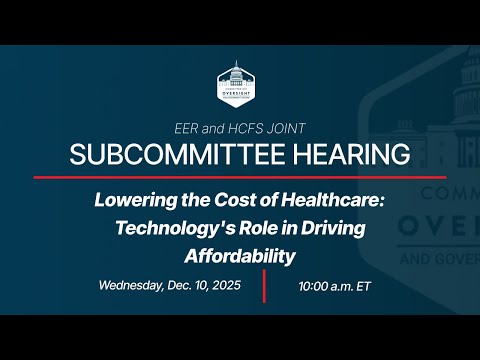
House subcommittees hear experts on health-tech as Democrats warn of ACA subsidy ‘cliff’
Summary
A House joint hearing examined whether health‑care technology and AI can lower costs, but Democratic members repeatedly pressed for an immediate, clean extension of enhanced Affordable Care Act premium tax credits that expire year‑end, calling the credits a lifeline for millions.
A joint House hearing on tech and health care on Dec. 24 brought experts to talk about how innovation, artificial intelligence and payment tools could reduce waste and improve care — but Democratic members repeatedly urged Congress to act now to extend enhanced Affordable Care Act premium tax credits set to expire at year‑end.
Ranking Member Frost told the panel he was “a little shocked” the committee held a hearing on innovation while, he said, congressional Republicans were blocking extensions of subsidies that help people afford insurance. “In just five weeks, the Affordable Care Act enrollment period ends,” Frost said, warning that people in his district could face premium increases of “50 to 300%.”
Families USA’s Sofia Tripoli called the credits “a lifeline” for millions and pressed lawmakers for a “clean extension immediately.” Tripoli told members that without the credits, people will drop coverage, delay care and increase emergency‑room use — outcomes witnesses and members on both sides said would undercut any technical gains from new tools.
Witnesses agreed technology can help reduce some costs but differed on how much it can substitute for coverage. Dr. Ziad Obermeyer of UC Berkeley said AI can improve clinical decision‑making and cut waste if researchers can access high‑quality data and regulators target evaluation on population‑level predictive performance. Brian Worley, CEO of Patient, urged broader use of “payment smoothing” (allowing patients to pay predictable cash prices over time) to ease out‑of‑pocket burdens.
Republican members pressed market‑based reforms and deregulation, with Chairman Grothman and others arguing that administrative waste and consolidation — not lack of technology — drive high prices. Witness Chris Jacobs criticized the Affordable Care Act’s design, arguing it encouraged consolidation and higher costs.
No formal actions or votes were taken. Members entered several documents for the record and left the committee with a clear political divide: Democrats and some witnesses arguing the immediate policy step is to extend subsidies to prevent coverage losses, and Republicans arguing for regulatory and market reforms to enable technology to reduce long‑term costs.
The committee adjourned after the chair set a five‑day window for members to submit additional materials and questions for the record.