Get Full Government Meeting Transcripts, Videos, & Alerts Forever!
Get email alerts on the Street Safety topic
No spam. Unsubscribe anytime.
Bowling Green hears Main Street bicycle and pedestrian study with multiple options for safety and mobility
Summary
Consultants presented a 2.5-mile Main Street study that recommends options ranging from restriping with on-street bike lanes to shared-use paths, pedestrian hybrid beacons and a possible single‑lane roundabout at Poe/Main; conceptual costs range from several hundred thousand for bypass segments to up to $15–20 million for curb‑and‑gutter rebuild options.
Consultants presented findings and conceptual options for a 2.5-mile Main Street bicycle and pedestrian study to the Bowling Green Council of the Whole, highlighting both safety concerns and multiple design alternatives.
The presentation summarized outreach and analysis: roughly 450 survey responses, a two‑day design charrette, traffic counts and a 10‑year crash review (2015–2024). The crash review identified 44 corridor crashes—25 bicycle‑related and 19 pedestrian‑related—with one fatality and seven serious injuries in the period examined. Consultants said those data support targeted safety interventions at several locations.
Design options are organized by corridor segments. Between Newton and Poe consultants proposed a pedestrian hybrid beacon (PHB) south of Dale Drive to mitigate frequent mid‑block crossings near restaurants and apartment complexes. For the large Poe/Main intersection, consultants presented lane‑reduction approaches and evaluated a single‑lane roundabout as a way to shorten pedestrian crossing distances and fit mostly within existing right‑of‑way.
For the four‑lane stretch from Poe south to Ridge and Clay, the team outlined three typical alternatives: Option A — a center two‑way left‑turn lane with on‑street bike lanes (striping and mill & fill); Option B — a raised median with on‑street bike lanes; and Option C — a center turn lane with an 11‑ft shared‑use path (west side), which would require curb work and potentially right‑of‑way acquisition.
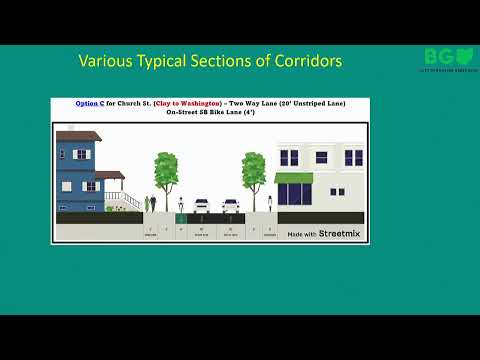
Through downtown, consultants described a bike‑bypass routing bikes to parallel side streets (Church and Prospect) as an alternative to continuous bike lanes on Main Street. They noted that retaining bike lanes on Main Street can be achieved by removing some exclusive right‑turn lanes and would add less than a second on average of peak‑hour delay at several intersections.
The team presented typical cross‑section dimensions used to evaluate tradeoffs: on‑street bike lanes commonly shown at 5 ft with a 2‑ft buffer and 10‑ft travel lanes, while shared‑use paths were sized at 11 ft with larger buffers. Consultants emphasized that options keeping improvements within existing curb‑to‑curb limits are substantially less costly than options requiring new curb, gutter and right‑of‑way work.
Conceptual planning‑level cost ranges (expressed in 2029 dollars) included: modest restriping options and on‑street bike lane conversions from roughly $2–3 million for certain sections; raised median options around $3–4 million; and curb‑rebuild/shared‑use path options in the range of $15–20 million for the more extensive corridor segments. Side‑street bypass work was estimated roughly $400,000–$600,000 for the sections reviewed.
Consultants also proposed corridor placemaking themes—"Story of the Swamp," "Journey Through Time," "Bountiful Bowling Green," and a town–gown concept referencing Bowling Green State University—that would guide streetscape elements if the city pursues sidewalk widening and aesthetic improvements.
No formal council votes or decisions were recorded in the transcript. Presenters said the written report and appendices will be finalized in the coming weeks and that staff will pursue funding for the options the city chooses to advance.