
Board adopts PEP policy after debate over ESA billing and access for low-income students
Get AI-powered insights, summaries, and transcripts
Subscribe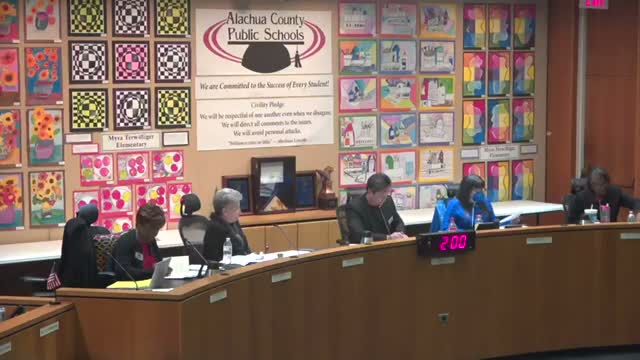
Summary
The board approved revisions to policy 9271 (Personalized Education Program) that add dual-enrollment language and leave fee/billing mechanics to contracts and procedures, after members debated whether to list ESA billing in the policy itself.
The Alachua County School Board voted on Dec. 16 to adopt revisions to policy 9271, which governs Personalized Education Program (PEP) students and dual-enrollment participation. The motion passed 4–1 after debate over how the district should handle fees and scholarship (ESA) billing for low- and middle-income families.
Deputy staff said the policy now allows PEP students to enroll in district dual-enrollment courses consistent with Florida statutes cited in the backup and that fee-payment options will be specified in written contracts rather than in the policy text. Several board members warned that removing direct reference to ESAs from policy could create access barriers unless the district commits operationally to direct billing through scholarship organizations such as Step Up.
“Removing the ESA language from the policy may harm lower- and middle-income students unless we guarantee billing will be done through scholarship organizations,” said a member who opposed the change. Staff and the deputy superintendent replied that the district plans to bill scholarship organizations directly rather than billing families up front, and that placing the detail in contracts and procedures preserves flexibility as state rules change.
Deputy staff also noted a newly added provision that explicitly allows dual-enrollment contracting consistent with state law. The board approved the policy on a 4–1 vote; the dissenting member asked staff to ensure procedures and contracts protect access for scholarship recipients.
What’s next: Staff will finalize contract language and procedures to implement fee payment and direct-billing arrangements and report back to the board; the district indicated it intends to coordinate with scholarship administrators to avoid requiring families to pay up front.