Get Full Government Meeting Transcripts, Videos, & Alerts Forever!
Get email alerts on the Theme Park District topic
No spam. Unsubscribe anytime.
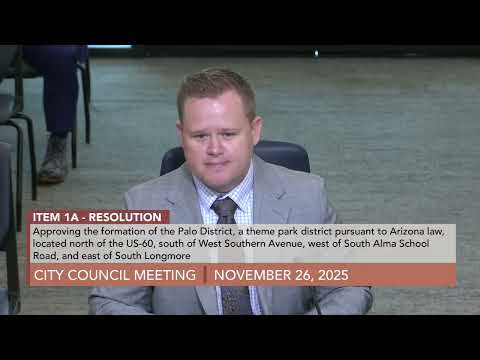
Mesa council unanimously approves formation of theme park district for Fiesta Mall site
Summary
Mesa’s City Council approved creating a four-member theme park district to redevelop the former Fiesta Mall site, elected two council members to the district board and approved a development and intergovernmental agreement; staff said the city will have no obligation for district debt.
Mesa’s City Council unanimously approved a resolution during a special meeting to create a theme park district covering the former Fiesta Mall site and to appoint two council members to the district’s governing board.
Jeff Robbins, the city’s redevelopment administrator, told the council the privately owned, roughly 80-acre property has been the focus of redevelopment planning since the mall closed in 2019 and demolition began in 2023. Robbins said the proposal would establish a separate legal and financial entity to support an entertainment-focused redevelopment and would include a development and intergovernmental agreement with the property owners.
Robbins said, “Theme park districts provide both a dedicated financing as well as a dedicated governance mechanism to support development and, in this case, redevelopment.” He added that districts may levy a district transaction privilege tax (TPT) within their boundaries and may issue revenue bonds, but that “this is not city debt” and the city would have no obligation to cover district debt.
The agreement before council requires district-built public improvements to meet city engineering standards and be dedicated to the city if so offered, and it requires property owners to maintain a replenishable fund to cover the city’s oversight costs. Robbins said businesses entering the district must sign a disclosure noting they may be subject to an additional district TPT in addition to state and local TPT.
Robbins also told the council a potential property tax exemption under state law could affect secondary property tax within the district; he estimated the secondary property tax impact in fiscal year 25 at about $17,500 but warned that figure does not account for future improvements that could change the calculation.
A council member asked for clarification: “Just just to confirm, what is the city's responsibilities after formation of the district? What, if any?” Staff replied, “There there really isn't. It's a separate ... taxing entity,” reiterating that formation creates an independent legal and financial body.
Robbins summarized the three actions before council: approve formation of the theme park district (referred to during the meeting as the Palo District and earlier in the meeting as the Apollo Theme Park District), elect two city council members to the district’s four-member board, and approve the development and intergovernmental agreement with the property owners. The council then moved to approve the resolution and the related appointments; the motion passed unanimously.
The council appointed Francisco Heredia and Richard Adams to the district board as the two city council members. The meeting record shows no council objections and a unanimous voice vote in favor. After the vote the council adjourned the special meeting.
What happens next: the district, once formed under Arizona law, will operate as a separate legal entity; under the IGA the city retains normal engineering and dedication standards for public improvements and the district and property owners retain financial responsibility for district debt and obligations.