
District staff outline IT and buildings & grounds budget requests, emphasizing consolidation savings and capital reserve plans
Get AI-powered insights, summaries, and transcripts
Subscribe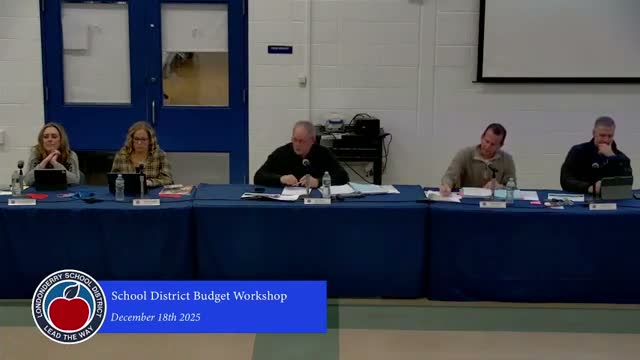
Summary
IT and facilities directors told the school board Dec. 18 that a modest IT budget increase is driven by hosted software and security packages, while buildings & grounds outlined capital priorities including roof work, gym floor repairs and a vehicle capital reserve to buy an infield groomer and replace an aging plow truck.
Two operational departments — information technology and buildings & grounds — presented their FY2027 budgets and multi‑year capital plans to the board.
Josh Parks, the technology manager, said the proposed IT operating budget is $1,176,975 (about 1% of the proposed operating budget), up roughly $42,775 from the last year; the default IT operating budget would be $1,136,500 if default spending is used. Parks said most of the increase is for software and hosting costs (the student management system moved to vendor hosting and online registration), and for renewed security monitoring (added AWARE monitoring and alerting). He described consolidation savings — for example, moving facilities ticketing to the IT inventory system — and noted E‑Rate discounts and consortium licensing that reduce annual costs.
Joe Parzic, director of buildings & grounds, outlined the department’s staffing and scale (44 employees, seven buildings, roughly 680,000 square feet and ~200 acres) and proposed capital reserve items: a prioritized roof replacement at Matthew Thornton identified by ARM Consultants, gym‑floor refinishing and bleacher replacement at North School, rooftop unit replacements and an ongoing vehicle capital reserve to replace an aging fleet unit (a 2016 Ford F‑250) and to buy an infield groomer to avoid recurring contracted repair costs. Parzic said in prior years the district had to hire a contractor for infield work at roughly $25,000 and that an inhouse groomer would reduce those recurring outsourced costs.
Both presenters answered detailed questions about equipment life cycles (for instance, network firewalls typically on a ~5‑year replacement cycle), software licensing overlaps (Microsoft server licensing vs. Google Workspace), and sums set aside in infrastructure/reserve funds ($125,000 proposed for infrastructure replacement to avoid large one‑time asks). Parzic described steps to reduce custodial supply costs (new cleaning chemical with an estimated $15,000 per year savings) and said the department is pursuing competitive bidding for certain contracts.
Board members asked for follow up on beginning fund balances and reserve account balances, and staff agreed to provide further detail in the next round of budget materials.