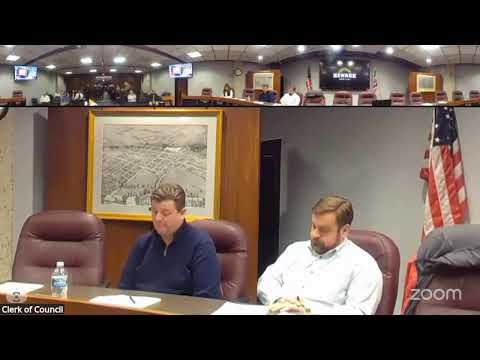
Council passes emergency ordinance to place 0.5% income-tax levy for police and fire on May ballot
Loading...
Summary
The Newark City Council passed Ordinance 25-48, declaring an emergency to put a half-percent municipal income tax dedicated to police and fire on the May primary ballot. Supporters said the revenue is needed after operating cuts; some members sought clearer, simpler ballot language.
The Newark City Council voted to adopt Ordinance 25-48, an emergency ordinance to place a 0.5 percent municipal income tax levy on the May primary ballot to raise revenue specifically for police and fire protection.
Supporters told the council the levy is targeted revenue meant to shore up safety services after steep reductions. "This money is desperately needed," a council member said, adding that "the police and fire department had to cut between 23 and 28 percent in their operating budget." Proponents argued tying the levy explicitly to police and fire would make voters more willing to approve new revenue than a general-fund request.
Opponents and some council members pressed for clearer, simpler ballot language and questioned whether the measure would be sufficient to fix citywide budget shortfalls. One council member asked whether the city had considered an income tax that would support the entire enterprise rather than a levy dedicated only to public safety. Another council member said the ordinance still leaves some uncertainty about how the new funds will be allocated in practice.
Council members also discussed timing. Officials said declaring the ordinance an emergency was necessary to meet filing deadlines with the board of elections to place the question on the May ballot; staff identified February 4 as an important deadline for the filing period. Council moved, seconded and voted to pass the ordinance; the measure was put forward with an emergency clause to allow immediate enactment once signed by the mayor.
The ordinance text requires employers and others subject to the tax to file returns, authorizes the city to collect and enforce the tax, and declares violations misdemeanors with penalties. Council members said they will work on simplifying the voter-facing explanation of the measure and clarifying whether the levy language should explicitly reference "earned income" to help seniors understand the impact.
The council’s next formal step is transmittal of the ordinance to the board of elections and finalizing ballot language; the measure will go to voters if the mayor signs the ordinance and administrative deadlines are met.