Get Full Government Meeting Transcripts, Videos, & Alerts Forever!
Get email alerts on the Ev Charging topic
No spam. Unsubscribe anytime.
Corte Madera reports early EV charger use, updates enforcement and plans more sites
Summary
Town staff reported 844 charging sessions and more than 8,000 kWh delivered since January 2025, said public chargers run at about 14–15% utilization and that recent ordinance and signage changes aim to prevent non-charging parking at stations; staff will reassess fees and site expansion in early 2026.
Corte Madera staff on Nov. 19 gave the Climate Action Committee an update on the town’s first public electric-vehicle chargers and steps to improve operations.
Phoebe, the town staff lead for the initiative, said the town installed six public chargers in January and has since worked to fix technical issues, improve signage and update municipal code to prevent vehicles from parking in charging stalls without charging. “There’ve been 844 charging sessions over 2000 hours of charge, and over 8,000 kilowatts of energy delivered,” Phoebe said, citing the Blink usage platform.
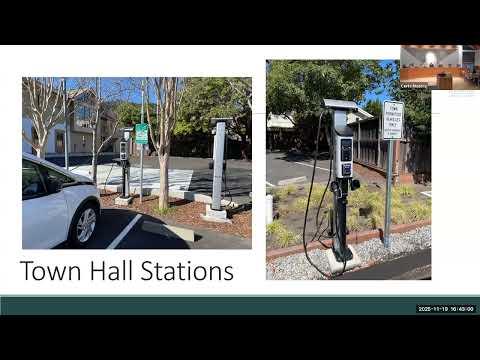
The staff presentation broke out site types. Two dual-port chargers at Town Park can supply 32 amps split between ports; when both ports are used, charging rates slow. Town Hall hosts a mix of fleet/staff and two always-public ports; fleet charging produces fewer but longer sessions. Phoebe said staff have begun a panel upgrade process with PG&E to allow increased amperage and potential additional capacity.
Committee members raised questions about signage and enforcement. Phoebe explained the town used California standard EV-charger signs: the top sign — “no parking except for EV charging” — applies at all times, while a separate four-hour charging limit is enforced between 5 a.m. and 10 p.m. Overnight charging remains allowed. The changes followed an ordinance the council adopted in August to prohibit non-charging parking in EV stalls and an updated fee resolution enforced by the town’s code-enforcement team.
On finances, Phoebe said the town is not yet breaking even at its fully public Town Park site. “We’re operating a little bit at a loss… about $80 or so a month,” she said, adding that the original fee of 42¢ per kilowatt-hour was intended to cover costs and staff will reevaluate fee levels after a full year of data in the first quarter of 2026.
Committee members suggested increasing outreach and promotion through the town newsletter and the charger maps to boost public awareness. Phoebe said the public-facing stations were added to mapping services in July and that staff will continue to evaluate future sites, including a potential site evaluation done by MCE for a location near the baseball field and consideration of the North Menke Park lot for additional charging capacity.
The committee did not take a formal vote on new charging locations at the meeting; staff will return with additional analysis and cost/revenue projections as part of next year’s work plan discussions.