
Appellate advocates agree Chris Green should be remanded for resentencing to range 2; court probes broader Erlanger question
Get AI-powered insights, summaries, and transcripts
Subscribe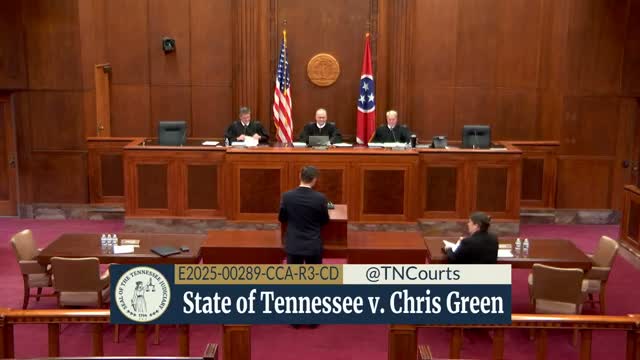
Summary
At oral argument, defense counsel William Gill and state counsel agreed the case should be remanded for resentencing under range 2, while the panel debated whether resolving the Erlanger constitutional question is necessary or would have wide implications for Tennessee sentencing law.
At oral argument, William Gill of the public defender's office, representing appellant Chris Green, asked the court to remand Green's sentence for resentencing under range 2; the state agreed that remand would provide the requested relief but urged the panel not to address a broader constitutional question under Erlanger.
Gill told the court that the appeal raises three issues: whether Tennessee's range-classification scheme is unconstitutional under Apprendi/Erlanger principles; whether a 1983 larceny conviction in the record is sufficiently proved and qualifies as a felony; and whether the trial court made the necessary findings to support $7,500 in fines. He said parties largely agree on the outcome but dispute which legal rationale the court should adopt.
"Tennessee's range classification as applied, is unconstitutional under Erlanger," Gill argued, contending trial courts sometimes must make factual findings about the timing of prior offenses that, under his reading of Erlanger/Apprendi, should not be made without jury findings. He acknowledged, however, that certain offenses not governed by the 24-hour merger rule (for example, robbery involving bodily injury) would still count for range purposes.
State counsel (identified in argument as General Ward) agreed the record supports remanding for resentencing to range 2 and told the panel that resolving Erlanger here would be premature. "We agree on the outcome for the most part, but we just disagree on the avenue to get there," Ward said, arguing this matter can be returned for resentencing without deciding the novel constitutional question under a plain-error framework.
The parties also disputed whether the record establishes a 1983 larceny conviction alleged in the pre-sentence report. Gill said the pre-sentence report and the North Carolina pen packet are "muddled and confusing," noting the same case number appears with different charges (breaking and entering vs. larceny) and no clear showing that the 1983 entry was a felony under North Carolina law — undermining its use to enhance Green's range.
On fines, the state urged that the record would support a $7,500 fine based on the severity of the assault against an elderly victim and what the state described as Green's ongoing criminal activity; the state also acknowledged the trial court did not make robust findings and told the court remand or de novo review are proper remedies. Gill countered that the pre-sentence report is unreliable to determine Green's ability to pay and asked the court to remand for resentencing so the trial court can make any necessary findings.
No ruling appears in the transcript. Counsel reserved five minutes for rebuttal, presented closing argument, and the court thanked counsel and called the next case.