Get email alerts on the State Budget topic
No spam. Unsubscribe anytime.
State lawmaker outlines budget boosts for Walker, highlights application support
Summary
State Representative Carol Glanville told Walker’s Committee of the Whole that the new state budget includes $1.6 billion in municipal revenue sharing, targeted public-safety grants, and substantial road and housing investments, and offered the legislature’s help with applying for grants and supplemental language.
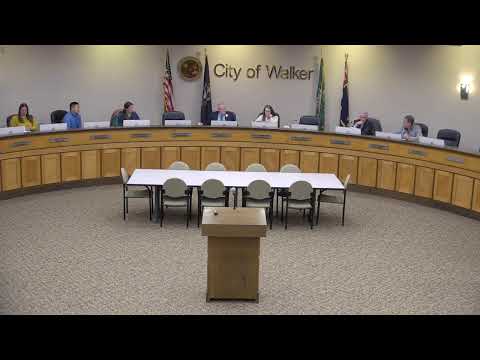
State Representative Carol Glanville visited Walker’s Committee of the Whole on Nov. 24 to summarize parts of the recently released state budget and what it could mean for the city.
Glanville said the budget includes $1,600,000,000 in revenue sharing across municipalities and that Walker may see shifts among funding “buckets,” with some ups in road funding and modest reductions in general constitutional revenue sharing. “The budget does have $1,600,000,000 of revenue sharing,” she said, offering her office’s assistance with applications and follow-up.
She outlined public-safety investments totaling $95,000,000, including community violence intervention grants (CVI), $8,000,000 for firefighter gear, $10,000,000 for MCOLS (police), $17,000,000 for county prosecutors and $25,000,000 in constituency grants directed at first responders. Glanville said application details were not yet fully specified and offered to help Walker apply for available grants.
On transportation, Glanville described sizable increases in local road funding and said the budget funnels more money to municipal road projects while noting some revenue sources—she specifically cited litigation over the marijuana tax—remain unresolved and could affect final allocations.
Glanville also cited investments in economic development and cultural institutions: roughly $60,000,000 for business attraction and community revitalization, $440,000,000 for workforce development in manufacturing, $32,000,000 for a “going pro” initiative, $17,000,000 for regional tourism, and $13,400,000 for arts and cultural institutions, including $2,000,000 for the Grand Rapids Art Museum.
On health policy, Glanville said Medicaid funding in the budget totals $29,000,000,000 with line-item amounts she read aloud (14.5 billion for physical health managed care, 5.5 billion for mental and behavioral health, and 4.5 billion for seniors and persons with disabilities). She also warned that the federal ACA enrollment deadline on Dec. 15 could affect coverage access for some residents.
Glanville described housing provisions—$500,000 to Habitat for Humanity statewide, $5,000,000 to expand permanent supportive housing for people facing chronic homelessness, and $14,000,000 redirected to land banks for community redevelopment—and said the legislature is requiring MSHDA to provide new reports on affordable housing production and progress. She said the budget also includes changes intended to reduce zoning-related barriers where federal law allows.
The representative closed by encouraging the city to contact her office early about any budget asks for next year so legislators can sponsor requests in the new process she called the LDS. She offered to help draft supplemental language and to connect city staff with program offices for application assistance.
What’s next: Glanville invited follow-up by email or meeting for more detailed questions; commissioners asked staff to coordinate with her office on particular grant applications and potential supplemental language.
AI generated
The text on this page is AI generated. Summaries, highlights, analysis, and video transcripts are all produced from the original source material.
AI can make mistakes, so if you spot one, and we will fix it for everyone.
Note: the source content is unaltered by us. Any content source we link to, be it a video, an audio recording, or a document, is presented exactly as its publisher released it. That publisher is usually a government body, sometimes an individual official or another organisation.