PGCPS reports early literacy gains, expands Amplify tutoring and adopts automated scoring for benchmarks
Loading...
Summary
At a Dec. 15 Academic Achievement Committee meeting, Prince George's County Public Schools officials reported a 98% DIBELS participation rate and preliminary Benchmark 1 gains (≈+5 points in reading and math), outlined Amplify virtual tutoring in 30 schools, and said Pearson automated scoring was used for reading constructed responses.
Chair Jonathan Briggs opened the Dec. 15 meeting of the Prince George's County Public Schools Academic Achievement Committee as staff presented beginning-of-year DIBELS results and preliminary Benchmark 1 performance. Dr. Jamie Bowers said the district completed beginning-of-year DIBELS testing in October with a 98% completion rate, representing 36,893 student assessments, and noted that reporting from vendor Amplify looks different this year after a platform change.
Bowers said grade 2 and grade 3 are ‘‘very close’’ to the district goal of 50% of students at or above the benchmark (reported at about 48% and 49%, respectively), with grade 1 at 46%. He highlighted subgroup results: approximately 32% of students identified for special education were at or above benchmark on composite DIBELS at the beginning of the year, and about 24% of multilingual learners were at or above. Bowers also flagged growth in kindergarten phonemic awareness (a reported 2-percentage-point increase) and described ‘‘students on the cusp’’—those within six composite points of the benchmark—who are targets for winter interventions.
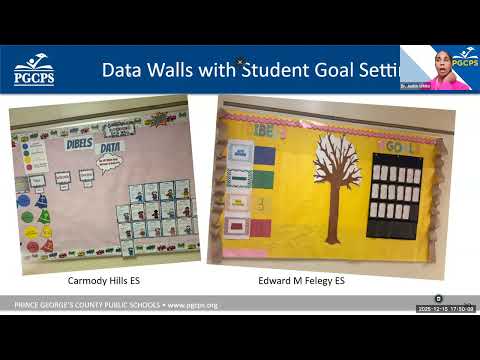
Officials described supports built around the data. Dr. Kia McDaniel and others said principals receive individualized, graphical data snapshots each month and that area instructional directors and performance specialists meet regularly with schools to translate results into instructional adjustments. Laquita Reed and Deborah Davidson were identified as staff who distribute results to principals after each administration.
The district is also continuing Amplify high-impact tutoring this year. A district presenter said Amplify tutoring is aligned to MClass/Amplify DIBELS, delivered virtually three times per week for 30 minutes, and is operating in 30 schools (plus two additional lab classrooms) with a focus on first and second grades. The program is intended for students below or well below benchmark, and the district reported that teachers can conduct ‘‘learning walks’’ to observe tutoring sessions.
On Benchmark 1, Bowers said this is the district’s sixth year administering its reading and mathematics benchmark program and reported about 164,000 benchmark assessments completed this administration (an increase of roughly 400 from the prior year). He said the district used the Pearson automated scoring engine this year for reading constructed responses (the same engine used on the state MCAP assessment) to reduce hand scoring workload. Bowers presented district-level gains of about 5.1 percentage points in language arts and 5.7 points in mathematics compared with the prior year, with notable gains at several grade levels (reading: grades 3, 5, 7, 8, 9 and 10; mathematics: grades 3, 4, 5, 7 and 8).
Bowers also explained a change to early numeracy benchmarks for kindergarten through second grade: the district is administering the same math benchmark form across the year to measure growth. For this first year of the new form, results are reported as percent-correct only pending a future standard-setting process; Bowers reported first-benchmark percent-correct at about 38% for first grade and 37% for second grade.
District staff emphasized these data are an early snapshot. ‘‘This is just one moment in time when we stop to come and provide data for you,’’ Dr. Judith White said, adding that schools continue to review monthly diagnostics and interventions and that the district will present updated results after Benchmark 2 in January.
The committee paused for questions and discussion and then moved on to the next agenda item. The committee is scheduled to reconvene Jan. 26, 2026.