Get Full Government Meeting Transcripts, Videos, & Alerts Forever!
Get email alerts on the Land Use Solar topic
No spam. Unsubscribe anytime.
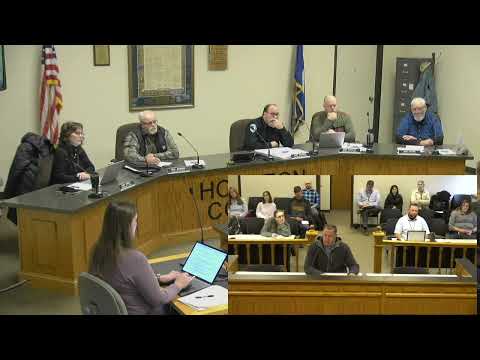
Houston County commissioners reject proposed commercial solar ordinance after months of debate
Summary
After extended public comment from farmers and developers, the Houston County Board voted down a proposed commercial solar ordinance and related comp-plan amendment, citing disagreements over allowing projects on prime agricultural soils and requests for more data and refined language.
The Houston County Board of Commissioners voted to reject a proposed ordinance to regulate commercial solar and an accompanying amendment to the comprehensive land use plan after a lengthy public and board discussion on whether solar should be sited on prime farmland.
Planner Amelia presented the draft ordinance and said the comp plan would need a new policy to allow review of distribution-level alternative energy systems. She described recommended references to the Houston County Soil Survey and the NRCS web soil survey and noted draft agrivoltaics and soil-health provisions. The draft also included a 25-acre limit intended to produce roughly a 5-megawatt project and a decommissioning clause for inactive facilities.
The draft prompted sustained public comment from local residents and agricultural stakeholders. "The proposed project on the Allen farm will not move forward in 2026," said Beth Eser, a representative of 1 Energy Renewables, attributing the delay to zoning changes and planning recommendations that exclude prime farmland. Landowners pressed landowner-rights arguments: "We bought that farm to grow a legacy for our boys," said Andy Allen, who urged the board to consider options that help small farmers. Farmer Ryan Herman argued that "dual use solar grazing sheep under solar is agriculture," describing agrivoltaics examples where livestock graze beneath panels and conservation benefits that can support farm viability.
Board members weighed competing priorities. Some commissioners emphasized the county's goal to preserve prime farmland, citing public input and a University of Minnesota survey that expressed concern about siting panels on prime soils. Others said limiting siting to marginal land would push potential projects away from substations, increase infrastructure costs and make projects economically unfeasible. Staff noted that the NRCS web soil survey and the county soil survey book would be used to identify prime versus marginal soils.
Chairperson (unnamed) moved to adopt the ordinance as presented; after roll call the motion failed. The board announced the ordinance "failed," and as a result the comprehensive plan amendment was not adopted. Commissioners directed staff to gather more data (including mapping of substations relative to prime soils), consider restoring or rewording struck language about agrivoltaics, and return a revised draft to the planning commission or to a workshop for further refinement. The county's moratorium on commercial solar timing was highlighted as a scheduling constraint for next steps.
The vote leaves the planning commission's recommendation unimplemented and signals additional work and outreach will be needed before a new proposal is brought forward.