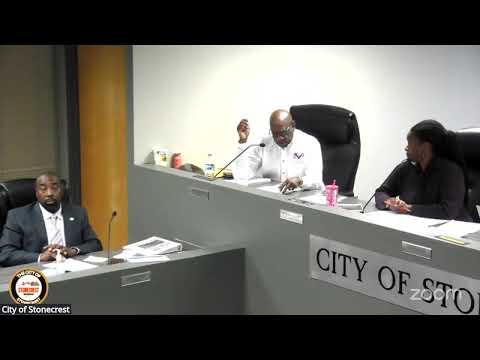
Stonecrest zoning board upholds staff limits on equipment storage in floodplain at 2219 Lithonia Industrial Blvd.
Loading...
Summary
The Zoning Board of Appeals upheld staff conditions requiring the applicant to provide additional post‑condition flood analysis before permitting outdoor rental‑equipment storage in a mapped floodplain at 2219 Lithonia Industrial Boulevard; the city engineer said the submitted NO RISE study did not analyze proposed encroachments and thus was inadequate to allow storage.
The City of Stonecrest Zoning Board of Appeals on Dec. 16 upheld a staff decision requiring additional analysis before allowing an equipment rental business to store machinery in a mapped floodplain at 2219 Lithonia Industrial Boulevard.
Staff presented background on Case B25‑004, saying a land‑disturbing permit for a paved parking area had been approved earlier but staff later found ongoing storage and past violations in the floodplain and recommended conditions on the business license to prevent parking and storage in that area. Staff cited city floodplain provisions and said any encroachment requires careful analysis to avoid increasing flood elevations.
Henry Bailey, counsel for the applicant, told the board he submitted a NO RISE study that was reviewed and approved by the city engineer and said most violations predated his client's ownership. Bailey said his client seeks to continue temporary outdoor storage of heavy rental equipment that circulates in and out of the site and offered to accept conditions to avoid downstream impacts. "We submit what you asked us to submit. You approved what you asked us to submit," Bailey said, describing an email chain and approval history he said supported his position.
The city engineer (name not stated in the record) told the board the NO RISE study evaluates existing conditions and that when applicants propose encroachments they must provide a post‑condition model showing the proposed encroachments do not raise flood elevations more than the ordinance allows. The engineer said the report that was submitted did not analyze the types of storage the applicant proposes and therefore does not support allowing storage in the floodplain. The engineer warned that temporary storage can still obstruct flood flows and cause downstream impacts.
Board members questioned whether a post‑condition NO RISE study had been submitted; staff and the planning director said the city had repeatedly asked the applicant for an adequate supplemental analysis and that it had not been provided in a form that addressed the intended storage. One board motion to overturn staff’s decision failed for lack of a second. A subsequent motion to uphold staff’s recommendation — that the applicant must provide additional, specific analysis of what will be stored and the post‑condition flood impacts before overturning the decision — passed by voice vote.
The record does not include an individual vote tally. The board’s action leaves in place staff conditions on the business license and requires the applicant to supply the additional post‑condition analysis before the board or staff will permit equipment storage in the floodplain.