Get Full Government Meeting Transcripts, Videos, & Alerts Forever!
Get email alerts on the Integrated Water Master Plan topic
No spam. Unsubscribe anytime.
Buckeye staff present draft Integrated Water Master Plan, plan to return to council for January adoption
Summary
City staff summarized a draft Integrated Water Master Plan that prioritizes wastewater recharge, regionalized water campuses and partnerships with irrigation districts and regional suppliers; staff said the plan will return to the council for adoption in January and answered questions on costs and permits.
Staff presented the City of Buckeyes draft Integrated Water Master Plan (IWMP), describing a two-volume guidance document that sets a 2040 planning horizon for water supply and infrastructure and recommends prioritizing reclaimed wastewater recharge and regionalized water campuses.
The presentation, delivered by a city staff member (Speaker 1), emphasized the plans two volumes (water resources and infrastructure) and the shorter 2040 horizon chosen because of rapid population growth and recent legislation. "It's a guidance document, not just for the city, but also for development," the staff member said, describing the plan as a tool both for municipal decision-making and for how developers design infrastructure.
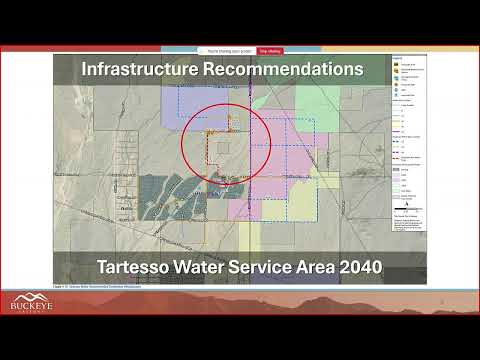
Why it matters: The plan outlines a shift from many small, development-level treatment facilities to larger, centralized water campuses that staff say will reduce duplication and operating costs. For Tartesso, staff said the draft envisions a centralized Tartesso Water Campus where wells and treatment would be located and from which water would be distributed to surrounding developments. "This regional approach also allows for a scalable approach," Speaker 1 said, adding that developers can partner on wells and treatment and the city benefits from operating a single facility.
Key recommendations and projects: Staff identified several priorities in the draft plan: - Prioritize recharge of reclaimed effluent into permitted underground storage to maximize long-term water credits and recover supplies; staff cited a permitted underground storage facility in the area with about 20 million gallons per day (20 MGD) of permitted capacity. - Develop a Tartesso Water Campus and other regionalized facilities to reduce per-unit infrastructure costs for developers and the city. - Pursue partnerships with local irrigation districts (identified in the transcript as the Buckeye Water Conservation District and the Roosevelt Irrigation District) and regional suppliers (named in the presentation as EPICOR and Goodyear) to act as wholesalers or conveyance partners. - Build recharge basins near existing conveyance (the transcript references a Cat Canal) and use adjacent recovery wells to return stored water to the distribution system.
Peer review and public input: Staff said the IWMP was developed over roughly two years and included a peer review session with local engineers and home builders who provided detailed comments. Officials reported receiving a couple hundred public comments; the most frequently raised items included recently enacted legislation, an "alternative designation" west of the White Tanks, and a recent high-profile water purchase referenced in the discussion.
Permits, legal issues and next steps: Staff told the meeting that some permits discussed during outreach remained pending and that they had no update on ongoing lawsuits mentioned by a council member. Regarding regulatory changes, staff said amending MAG 208 to reflect the plans changes would be largely a paperwork exercise. The presenter said the next step is to return the IWMP to the council for adoption in January, with a likely hearing date mentioned as January 6.
Questions from council members and others focused on developer cost impacts, whether regionalization would reduce developer expenses, how underground storage basins function (natural/permitted basins versus constructed reservoirs), and the status of pending permits. Speaker 1 responded that regionalization should be more cost-effective and explained the basin and recovery-well process in plain terms.
What the plan does not yet resolve: Staff acknowledged that the plan remains partly "fluid" because of fast-changing legislation and resource availability; several details (including outcomes of pending permits and some legal questions) were described as not yet resolved or "pending" in the outreach period.
What happens next: The presenter said the plan will come back for council adoption in January. Technical staff and consultants will be available for follow-up questions in the interim.
Ending: The council thanked presenters and closed the meeting, noting the plan will return for a formal adoption vote in January.