Get Full Government Meeting Transcripts, Videos, & Alerts Forever!
Get email alerts on the Community Science Bird Monitoring topic
No spam. Unsubscribe anytime.
Tracy Aviary’s volunteers document 167 bird species at Utah Lake, data to guide habitat work
Summary
Tracy Aviary’s community science project at Utah Lake’s North Shore, started in 2020, has recorded 167 bird species through systematic point‑count and transect surveys; organizers say volunteer contributions and multi‑year trends will inform local habitat management.
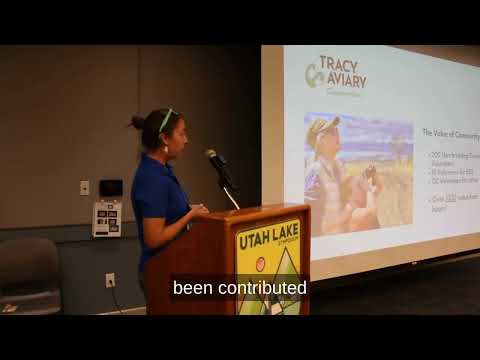
Angie Trumbo, director of conservation at Tracy Aviary, presented findings from a community science bird‑monitoring project on Utah Lake’s North Shore, saying the effort has detected 167 unique bird species since it began in 2020.
Trumbo told attendees the project uses two primary survey methods: six‑minute, fixed GPS point counts during the April–July breeding season and monthly transect surveys in the nonbreeding season. "Point count surveys are where we navigate to a very specific GPS point, and we're doing a 6 minute survey where we record every single bird that we identify by both sight and sound," Trumbo said, describing how teams record direction and distance to estimate habitat use and population density.
The monitoring team established eight survey points along the North Shore. Since 2020 the program has completed 28 rounds of breeding‑season surveys, 36 nonbreeding surveys and 18 other surveys that include training, evening owl surveys and Christmas bird counts. Trumbo said volunteers — about 200 on nonbreeding surveys, 18 for breeding seasons and roughly 130 who joined other surveys — have contributed more than 1,000 hours to the project.
The data show seasonal and species‑specific variation. Trumbo highlighted a late‑summer peak in species richness in August–September and lower richness in December–January, and noted year‑to‑year fluctuations that may relate to weather or habitat changes. "We have detected a 167 unique species just in that small area on the North Shore of Utah Lake," she said. On species trends, Trumbo reported that detections per survey for Franklin's gulls have decreased since 2021 while red‑winged blackbird detections have increased.
Trumbo said the survey results help identify where habitat improvements could have the greatest benefit. She used removal of invasive Russian olive trees as an example of a management action with short‑term and long‑term trade‑offs: although invasive, those trees can provide food and shelter, so removal may temporarily reduce some species even as it improves native habitat over time.
Comparing North Shore counts with other Tracy Aviary sites along the Jordan River and at the Great Salt Lake Shorelands Preserve, Trumbo said Utah Lake supports both overwintering and migratory birds at levels comparable to larger sites such as Big Bend. Beyond scientific value, Trumbo emphasized community outcomes: volunteers gain skills, stronger place attachment and often become advocates who bring others to the site.
Trumbo closed by inviting participation: she encouraged interested people to scan a provided QR code or contact the project at conservation@tracyeva.org for volunteer opportunities and partnerships. She also thanked supporters and volunteers who contributed to the monitoring effort.