Get Full Government Meeting Transcripts, Videos, & Alerts Forever!
Get email alerts on the Arts And Culture topic
No spam. Unsubscribe anytime.
UVU Museum’s ‘Healing Waters’ exhibition drew thousands and sought to reframe Utah Lake
Summary
UVU Museum of Art displayed 'Healing Waters,' a multi-artist exhibition co-curated by Terry Harmon that ran about four months, included 50 artists, public programs, partnerships with local organizations, and recorded 6,679 visits.
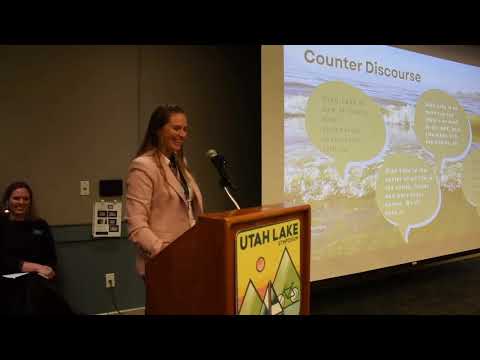
Emily, the museum director (identified by first name only in the transcript), described the UVU Museum of Art's 'Healing Waters, restoring our relationship with Utah Lake' exhibition, which the museum produced with community partners and a public open call for art.
Emily said the museum accepted roughly one-third of submissions and ultimately exhibited about 50 artists across five gallery spaces. The exhibition combined artworks, site-specific installations, a community memories wall for public submissions, historical photos and artifacts on loan from the BYU Museum of Peoples and Cultures, and accessible scientific reports to help visitors learn about the lake's ecology.
Featured projects included a painting series by Downey Doxey Marshall focusing on surface waters, a fiber-art project by Shireen Abedenerad titled 'Rooted Resonance,' and a large site-specific reed installation by John Forsyth that served as a contemplative labyrinth during the opening reception. The museum also ran public programs—panels on science, literature readings, a plein air workshop led by Chantelle Clements, and a forest-bathing session on the North Shore.
Emily credited partnerships and contributions from organizations including the Utah Lake Authority, Conserve Utah Valley, Tracy Aviary, Grow the Flow, the BYU Museum of Peoples and Cultures, Utah Humanities, and Save the Great Salt Lake. She said the exhibition and its programs ran for about four months and recorded 6,679 visits, including repeat visitors, and that a virtual version of the exhibit would be posted online soon.
The museum director closed by encouraging other institutions to host similar community-engaged projects to pair science and the arts in support of lake stewardship.