Get Full Government Meeting Transcripts, Videos, & Alerts Forever!
Get email alerts on the Public Opinion topic
No spam. Unsubscribe anytime.
Researcher: Negative ‘Utah Lake’ Narrative Persists; calls for storytelling to change public perception
Summary
Terry Harmon presented a discourse analysis showing dominant negative public narratives about Utah Lake and urged artists and storytellers to create embodied experiences that can shift emotions and community identity about the lake.
Terry Harmon, director of public outreach for Conserve Utah Valley and a graduate student in environmental humanities, told attendees at the Utah Lake Nerds annual gathering that public comments and social media responses overwhelmingly repeat a negative narrative about Utah Lake.
Harmon said he examined comments tied to a recent MyLake media campaign and other posts and read sample remarks such as, "Utah Lake is nothing but a sewer" and "Utah Lake is filthy, shallow, dangerous," to illustrate common themes. He reported that in one social-media sample roughly 69 of about 100 comments repeated the negative framing, about eight offered positive counterpoints, and the rest argued among themselves.
Harmon argued the negative discourse is embedded in local place identity and that simply supplying scientific facts often fails to change minds because people process information emotionally. "Stories are one of the best ways we do that," he said, urging that art, photography, and other encounters put bodies in places to form new memories about the lake.
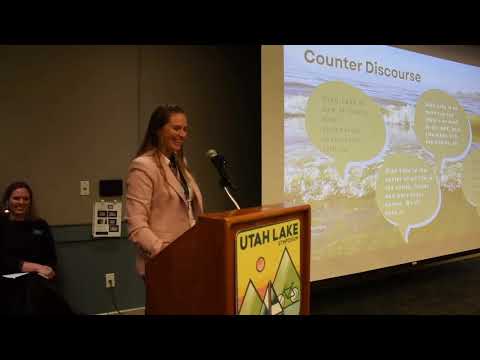
As examples of counter-discourse, Harmon described his own creative nonfiction and photography work and cited an art exhibition he co-curated at the UVU Museum of Art. He proposed practical outreach actions, including community events and symbolic efforts (he mentioned starting a petition to make the June sucker the state fish) to generate interest and reshape narratives.
Harmon also noted public mistrust of sources connected to government or official institutions, saying that skepticism toward institutions such as the Utah Lake Authority can blunt the effect of outreach tied to those organizations. He called for collaborations that include artists and storytellers alongside scientists to make messaging emotionally resonant.
The presentation concluded with Harmon inviting the cultural community to help create "counter-discourse"—new stories and experiences that acknowledge the lake's complexity rather than trying to erase the negative parts of its history. He then introduced the UVU museum director to describe a related exhibition.