Get Full Government Meeting Transcripts, Videos, & Alerts Forever!
Get email alerts on the Water Supply Plan topic
No spam. Unsubscribe anytime.
Port Washington consultants recommend staying on Lake Michigan, favor expanding service area north
Summary
Strand consultants told the Board of Public Works the city should remain on Lake Michigan for its long-term drinking-water supply and adopt the larger Service Area 2 to accommodate projected growth, including a proposed data center; plant expansion and booster stations would be needed only if high-demand scenarios materialize.
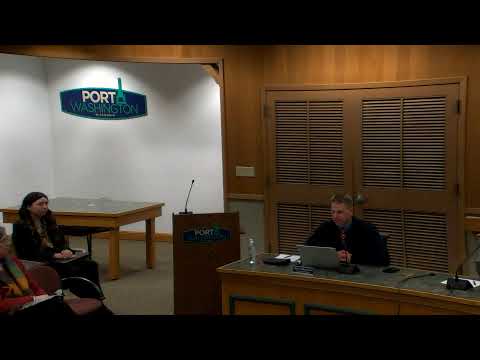
Consultants from Strand presented a Water Supply Service Area Plan required under DNR rule NR 8 54 and recommended the City of Port Washington remain on Lake Michigan as its primary source and adopt Service Area 2, which would extend service north into parts of the Town of Port Washington.
Ben, the presenting consultant, told the board the plan considers a 20-year planning horizon, alternate sources and service areas, environmental impacts and cost-effectiveness. "We're gonna recommend that you stay on lake water," he said, calling lake supply the most cost-effective option that avoids impacts to local aquifers.
The board heard three service-area scenarios: Service Area 1 (current municipal boundaries with typical growth), Service Area 2 (city growth plus adjoining town lands and a proposed 1,700-acre data-center area) and Service Area 3 (city growth plus wholesale sales to Saukville). The analysis modeled both the developer’s early conceptual data-center request of 1.2 million gallons per day (MGD) and lower, site-specific estimates for the first phase. Ben said the data-center developer refined the phase 1 request for about 680 acres to roughly 20,000 gallons per day for that phase, but staff retained the 1.2 MGD planning value to test impacts.
Strand’s demand modeling and capacity review show the city’s water treatment plant is currently rated at about 4.0 million gallons per day. Under the conservative, higher-demand scenario the system’s maximum-day demand could approach approximately 3.87 MGD by 2035, which would require planning for treatment-plant expansion; in that scenario the firm estimated a modest additional capacity need by 2045. Under baseline assumptions the present plant capacity would meet projected maximum-day demands across the 20-year planning period.
Consultants identified infrastructure needs beyond the plant: replacement of aging booster stations, new water mains to serve developing areas, and storage upgrades. Those distribution costs are typically borne by developers. High-level cost comparisons presented by the consultant showed an estimated $55.5 million to convert entirely to groundwater, versus an estimated $10 million to expand the plant to 6 MGD when needed and a high-level $12 million opinion for a new booster station.
Board members questioned the assumptions for growth (the plan uses an average 2% annual population-growth assumption over 20 years that incorporates known development inquiries), the treatment of industrial customers in Saukville’s projections (Charter Steel was incorporated in Saukville’s demand totals if it remains an existing customer), and the mechanics of wholesale service. Ben said DNR would require any mixing of surface and groundwater sources to be carefully evaluated and that wholesale sales to Saukville would likely require a full wholesale arrangement (not piecemeal mixing of sources) and a plant expansion before service begins.
The plan is non-reviewable under current DNR rules, meaning it need not be submitted to DNR for approval, but the city must have the plan on file and available and update it at least every five years or sooner if the city pursues a treatment-plant capacity increase. The board was told the same material will be presented at a public hearing scheduled for Dec. 16 and the consultant team will return for a fuller presentation in coming weeks.
What happens next: the public hearing will allow public comment; if development requests or actual demand growth bring the city near treatment-plant capacity, staff and the city would work with DNR on a reviewable plan and any required approvals.