
Port Washington outlines multiyear plan to restore Valley Creek corridor
Get AI-powered insights, summaries, and transcripts
Subscribe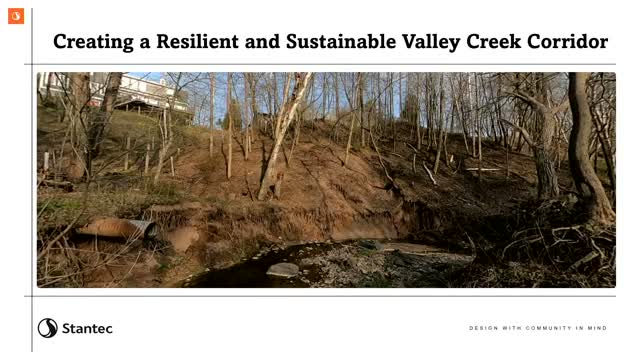
Summary
City staff and consultants presented a 30% design for a nature‑based restoration of the Valley Creek corridor, citing nearly $2 million in grants to date, $1.4 million secured for design, and an estimated $12–$15 million construction cost; construction could begin as early as 2027 pending funding.
Port Washington public works officials and consulting partners told a packed public information meeting that a multiyear project to restore and stabilize the Valley Creek corridor is advancing through design and will rely on external grants for construction.
"My name is Rob Vandenove, and I'm the director of public works here in Port Washington," Vandenove said, reminding attendees that the project grew out of significant flooding in 2018 that damaged property on Lake Street and threatened the city's water and sewer infrastructure. He said the city has secured nearly $2,000,000 in outside grant funding to date to pursue the work.
Melissa Curran, a Stantec consultant leading the stream restoration design, said the team has completed roughly 30% of design work and has about $1,400,000 in design funding for the stream portion. "In the end this all we anticipate it'll be probably a 12 to $15,000,000 project once we get through the whole construction phase of the project," Curran said, adding that the team is "on the hunt for more money" and aims to fund construction with grants and resources outside the city. She also noted one of the project grants was "1 of 3 that was awarded in the Great Lakes region. It was a national grant."
Amy Lentz of the Lakeshore Natural Resource Partnership described outreach and partnerships that support the project, including work with the UW–Milwaukee School of Freshwater Science and Wisconsin Sea Grant. Lentz said undergraduate capstone teams provided baseline data and that the partnership has produced drone footage and a story map to explain the work to residents.
Heather Schwarr, a stream restoration engineer, outlined the project's nature‑based approach. "It is solutions that take the power of nature and give us solutions to help our environment…to protect and stabilize our infrastructure," she said, describing plans to raise the low‑flow channel, reconnect floodplain areas, stabilize banks with wood and rock, and create riffle‑pool or step‑pool sequences depending on reach to slow erosion and improve habitat.
Aaron, a water resources and stormwater engineer on the team, reviewed stormwater measures including regenerative stormwater conveyance at problematic outfalls, concept work for the Walter Street Ravine and options to improve trail access. He said the project concept calls for replacing or upsizing undersized culverts at Norport Drive and Hales Trail and addressing a larger box culvert at Lake Street to reduce upstream backing and erosion and to improve fish passage.
Presenters closed by asking residents to complete surveys, sign up for follow‑up, and visit breakout stations to speak one‑on‑one with team members. Staff said they expect to advance design over the next six months and will continue seeking construction funds; while construction could begin as early as 2027, timing will depend on securing additional grants.